Bill Clinton Quotes
The Republican idea of a compromise is that they take only 90 percent of what they want and the Democrats get nothing.
At the time many of the Republicans wanted to solve the deficit by cutting non-defense and non-homeland security spending only and was opposed to any increase of taxes or any closing of tax loopholes despite the fact that taxes were at the lowest rate that they had been since before the Second World War. The Democrats wanted to increase taxes for the most wealthy Americans by repealing the tax cuts for the wealthy that the George W. Bush administration passed. They were willing to cut spending for the military but did not want to cut services for poor and middle class people—especially Medicare and Medicaid. The public was calling for a compromise and some Republican leaders said that they would agree to cutting a little less than they had originally insisted upon, but would not budget on repealing the tax cuts for the wealthy or in closing tax loopholes for corporations. This triggered the Clinton’s statement. While this quotation was an accurate description for Republican behavior at the time, historically it was not typical of Republicans before that time when the Republican and Democrat view of compromise
William Clinton, 42nd President of the United States (Democrat, AR), Interview with Wolf Blitzer, CNN News, June 30, 2011
Sourced by: Eigen's Political and Historical Quotations

At the time Congress was gridlocked in bitter hyperpartisan conflict. Most people called for more comity and bipartisanship and most politicians wanted more bipartisanship but blamed the other party for the rift. Mourdock,arguing for less bipartisanship and no compromise defeated Richard Lugar in the Republican Senatorial Primary election. Lugar, one of the most respected and effective Senators was a statesman who worked with any and all to find effective compromises to reach national solutions. The nation was so politically polarized that the Republican Indiana voters ousted one of their most senior senators because he was effective at developing national solutions. See {626717} and {302706} for other Mourdock outrageous comments. While this rhetoric won in the Primary, it lost him the general election in a state where Republicans had a strong majority and should have had the seat.


This was one of the worst Congresses in American History and had the worst productivity record—passing very few bills, and none of any significance. The anti-government, Tea Party hyper-conservative Wing of the Republican Party intimidated the Speaker of the House and they were opposed to any compromise at all on anything.


In 2011 nd 2012 a right wing extremist group—the Tea Party-were able to intimidate the Republican Congressional leadership to take the extreme partisan view that why would allow no significant legislation to pass as it might strengthen Democrat president Obama’s chances of getting reelected. Therefore there was to be no cooperation or even negotiations with the Democrats in Congress. Lugar a highly respected Republican Statesman, and expert on Foreign Affairs, followed his usual pattern of trying to develop legislation that would benefit the country. The Tea Party and some of the more partisan regular republicans then ran a candidate in the state primary election sending huge amounts of money to defeat Lugar who was a sure winner in the general election as he was very popular with all groups in Indiana ecept the right wing extremists, racists and fascists. Lugar never had the chance to win the election. He was defeated in the primary for working with Democrats.

Actually, it was the Tea Party members of the Republican Party whose unprecedented willingness to risk the full faith and credit of the United States when the majority of the Republican legislators and almost all the Democrats were not, who held the required Debt Ceiling Increase hostage to getting their legislative way. But in this particular debate and legislation the Democrats gained nothing except that the anger of the American People was much greater against the Republicans than the Democrats, many of whose usual supporters thought that the Democrats had been totally intimidated by the Tea Party.


At the time, the Republicans held the House of Representatives, but not the Senate or the Presidency. By popular vote, even the House elections had the majority voting for the Democrats, but the gerrymandering gave the Republicans more seats. A minority of the minority Republicans were Tea Party Republicans—ultra conservatives who would not compromise but who intimidated other Republicans by threatening to run candidates against them in primary elections. The result was that the Tea Party Republicans—a minority of the minority could block almost any legislation and did. That Congress passed less legislation than any in American history including the “Do Nothing Congress” of the Truman era.

The Republicans had, in the view of most Americans at the time, refused to pass the legislation to provide money for the government to function unless President Obama would cancel the Health Care Reform that was his major legislative achievement of his first term, and passed over the objections of most Republicans who claimed it was unconstitutional. Then the Supreme Court upheld the Constitutionality of Obamacare, and the Tea Party Republicans pressured the regular republicans to shut down the entire government until the President relented and cancelled his own legislation. The American people resented this unprecedented of interfering with the Constitutional methods by which laws are passed, and after over a week of taxpayer additional costs for less service, the regular Republicans made a deal with the Democrats and produced a majority to reopen the Government.

The government was reopened when the more rational Republicans combined with the Democrats and voted the appropriations necessary to reopen the government.


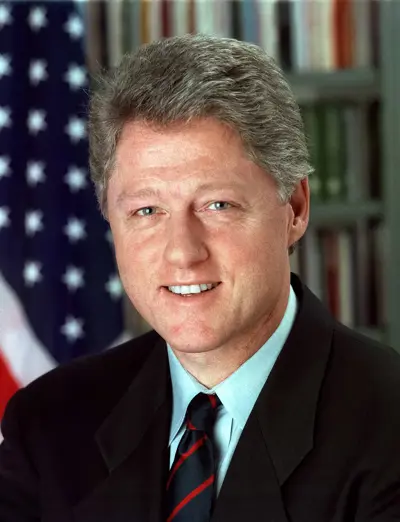
William Jefferson "Bill" Clinton is an American politician who was the 42nd President of the United States from 1993 to 2001. Clinton was previously Governor of Arkansas from 1979 to 1981 and 1983 to 1992, and the Arkansas Attorney General from 1977 to 1979. Clinton was born William Jefferson Blythe III – he changed to his stepfather's name at age 15.
