Samuel Butler Quotes
The public buys its opinions as it buys its meat or takes in its milk, on the principle that it is cheaper to do this than to keep a cow. So it is, but the milk is more likely to be watered.
Samuel Butler, 1835-1902, British Satirical Writer, Notebooks
Sourced by: Eigen's Political and Historical Quotations


He was parodying Lincoln’s famous quotation: {609284}.


The conclusion that almost all scientists who have studied the problem of climate change and global warming us that there is a substantial change ongoing. That conclusion is reached as the result of literally thousands of observations and studies about the many aspects of climate change. Like any other science, a number of studies have flaws and there are many who fear that government funds will be used to cope with climate change at a cost to the economy. They point to the flaws of individual studies or researchers and have spent millions of dollars to produce uncertainty into the mind of the pubic and politicians. Science, however, ALWAYS has uncertainty and flaws are ALWAYS discovered in established scientific principles. It does not mean that these larger theories and principles are wrong if several of the studies or points are wrong and are understood in a larger and more sophisticated context. Einstein’s Theory of Relativity could be foolishly be called wrong because Einstein did not take account of what would become Quantum Mechanics and there were some contradictions. None the less Relativity is still the most important physical discovery of all time and influences all thinking in physics even though he could not account for the very small physics of quarks, electrons and other atomic particles.
Amy is responding to Michelle Obama’s claim that “any woman who voted against Hillary Clinton voted against their own voice.”


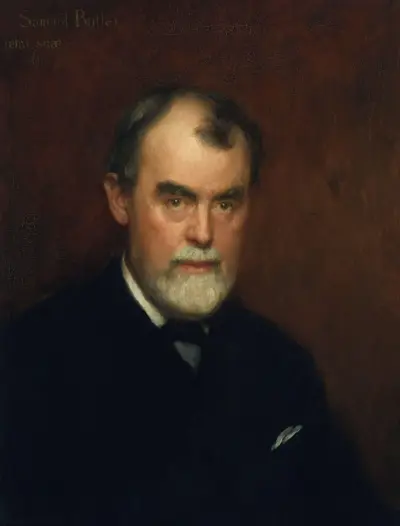
Samuel Butler was an English novelist and critic. He is best known for the satirical utopian novel Erewhon (1872) and the semi-autobiographical The Way of All Flesh, published posthumously in 1903. Both have remained in print ever since. In other studies he examined Christian orthodoxy, evolutionary thought, and Italian art, and made prose translations of the Iliad and Odyssey that are still consulted today.
