Wole Soyinka Quotes
The problem with literature, with writing, is that it works sometimes in terms of correction of social ills. Other times, it just does not suffice. The proof of that is the ability of a dictator to snuff out the life of a writer.
Jeyifo, Biodun, editor. Conversations with Wole Soyinka. University Press of Mississippi, 2001.


He and 8 others were executed by the military dictatorship which controlled Nigeria. It was led by General Sani Abacha who was the chief “goon” to whom he was referring. His observation is a fundamental of protest activities in countries of high illiteracy. Printed literature is relatively impotent in an oral, illiterate country. But “literature in the streets” is the oral protest of large groups of people. Because he was so effective at organizing this, he was executed on trumped up charges and his body hidden from his followers and relatives. See {586598} and {586596}.

The editorial was defending the two published cartoons depicting the Muslim Prophet Muhammad which were offensive to Muslims throughout the world.


Spinoza’s ideas were considered so radical and dangerous that he was the only man in history who was excommunicated by the Catholics, the Jews and the Muslims. However, we see in Spinoza the observations and foundations of what would become American and then international views of human rights.

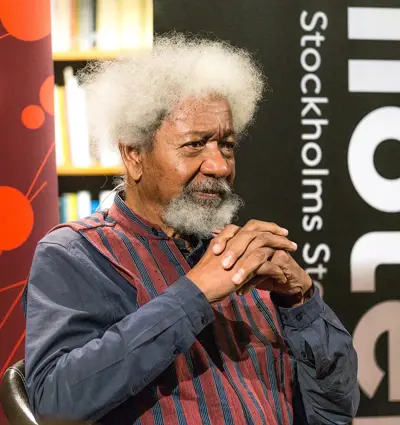
Akinwande Oluwole Babatunde Soyinka, known as Wole Soyinka (pronounced [wɔlé ʃójĩnká]), is a Nigerian playwright, novelist, poet, and essayist in the English language. He was awarded the 1986 Nobel Prize in Literature, the first sub-Saharan African to be honoured in that category. Soyinka was born into a Yoruba family in Abeokuta. In 1954, he attended Government College in Ibadan, and subsequently University College Ibadan and the University of Leeds in England. After studying in Nigeria and the UK, he worked with the Royal Court Theatre in London. He went on to write plays that were produced in both countries, in theatres and on radio. He took an active role in Nigeria's political history and its struggle for independence from Great Britain. In 1965, he seized the Western Nigeria Broadcasting Service studio and broadcast a demand for the cancellation of the Western Nigeria Regional Elections. In 1967, during the Nigerian Civil War, he was arrested by the federal government of General Yakubu Gowon and put in solitary confinement for two years.
