Milton Friedman Quotes
The power to determine the quantity of money... is too important, too pervasive, to be exercised by a few people, however public-spirited, if there is any feasible alternative. There is no need for such arbitrary power... Any system which gives so much power and so much discretion to a few men, [so] that mistakes - excusable or not - can have such far reaching effects, is a bad system. It is a bad system to believers in freedom just because it gives a few men such power without any effective check by the body politic - this is the key political argument against an independent central bank.
Friedman, Milton. Capitalism and Freedom. University of Chicago Press, 1962, p. 50.


Attempting to defend charges that his bank and others were engaged in monopolistic practices:


Prior to that the practice of the Fed was simply to make interest rate and other decisions and never discuss or explain anything. And they never tried to use words to try and change economic behavior. See {639156} for the Fed Chairman’s practice. However in 2001 that changed and they used language to shape investor and consumer behavior.

The ‘Fed’ refers to the Federal Reserve Board, the strength of which lies in its independence from politics. Some, however, believe that there should not be any entity that performs a major function in our society which is not accountable to the Executive Branch or the Congress or both.

The legislation creating the Federal Reserve Board was then being debated. A few days later it passed despite reservations from Lodge and others. The powers relegated to the Federal Reserve Board have been debated ever since.


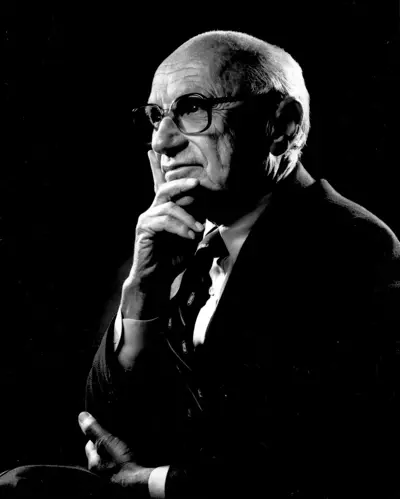
Milton Friedman was an American economist and statistician who received the 1976 Nobel Memorial Prize in Economic Sciences for his research on consumption analysis, monetary history and theory and the complexity of stabilization policy. With George Stigler and others, Friedman was among the intellectual leaders of the Chicago school of economics, a neoclassical school of economic thought associated with the work of the faculty at the University of Chicago that rejected Keynesianism in favor of monetarism until the mid-1970s, when it turned to new classical macroeconomics heavily based on the concept of rational expectations. Several students and young professors who were recruited or mentored by Friedman at Chicago went on to become leading economists, including Gary Becker, Robert Fogel, Thomas Sowell and Robert Lucas Jr.
