Ben Bernanke Quotes
The Fed's policy choices can always be debated, but the quality and commitment of the Federal Reserve as a public institution is second to none, and I am proud to lead it.
Bernanke, Ben S. The Courage to Act: A Memoir of a Crisis and Its Aftermath. W. W. Norton & Company, 2015, p. 574.


The ‘Fed’ refers to the Federal Reserve Board, the strength of which lies in its independence from politics. Some, however, believe that there should not be any entity that performs a major function in our society which is not accountable to the Executive Branch or the Congress or both.

The Federal Reserve has by law a great deal of confidentiality, including restrictions on the right of Congress to audit the Federal Reserve. Democratic and Republican administrations and most members of Congress have thought that a few members of Congress would abuse any audit powers they would be given and that they are less to be trusted than the Federal Reserve Board.


Volcker was politically very independent and the President was facing re-election. Carter appointed him. The Federal Reserve took actions that were unpopular with most voters. Carter couldn't control the Federal Reserve. He lost the election.

Jefferson was of the opinion that a central bank was unconstitutional and that it was a great economic danger to the nation, a view also held later by President Andrew Jackson.


The legislation creating the Federal Reserve Board was then being debated. A few days later it passed despite reservations from Lodge and others. The powers relegated to the Federal Reserve Board have been debated ever since.
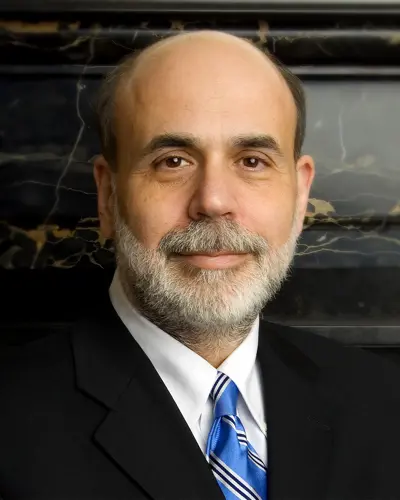
Ben Shalom Bernanke is an American economist at the Brookings Institution who served two terms as the 14th Chair of the Federal Reserve, from 2006 to 2014. During his tenure as chair, Bernanke oversaw the Federal Reserve's response to the late-2000s financial crisis, for which he was named the 2009 Time Person of the Year. Before becoming Federal Reserve chair, Bernanke was a tenured professor at Princeton University and chaired the department of economics there from 1996 to September 2002, when he went on public service leave.
