Charles Murray Quotes
The people who run the country have enormous influence over the culture, politics, and the economics of the country. And increasingly, they haven't a clue about how most of America lives. They have never experienced it.
Murray, Charles. Coming Apart: The State of White America, 1960-2010. Crown Forum, 2012.

1st Earl of Beaconsfield. See Thomas Jefferson for a similar view.


The term “rugged individualism” was used at the time be very conservatives and the very wealthy to describe business leladers with words that had very good public connotations. They argued that it would be undesirable to curtail their individualism that was so important by any government regulations or laws that would limit what the business leaders could do. However, the reality was that these very successful and powerful “rugged individualists” had regimented most everyone else—employees, consumers, and small businessmen who might sell them services or products. To Tugwell, if the wealthy and powerful few had no restrictions on their individualism, there would be precious little individualism for most of society. He sought a balance of regulating the individualism and prerogatives of the few somewhat in order to allow the vast majority of people to be able to have individuality as well.

The Souther politicians sold their poorer people on a notion of Trickle Down whereby they could be much better off in a slave society than with abolition as in the North. They managed that despite that fact that the standard of living in the North for the poor was generally much better than that of the South and there was certainly more possibility of social and economic mobility. One of the other points which De Bow himself had a part in selling (See Quotation 643677) was that under a slave society the poor white was not at the bottom of the society while he would be without slavery.


This important statement would not have been a noteworthy quote as so many have said it before, except for the fact that she was writing as a spokesperson of Nationalist China and she was the wife of the Nationalist Party leader, Chiang Kai-Shek. And the great failure of Chiang’s governance was the corruption and the excessive exploitation of the Chinese people by the wealthy. Madame Chaing, educated at Vassar College, knew just what to say to Americans and she mustered incredible support for the Nationalist cause most of which would never have been forthcoming if Americans knew the truth about the Nationalist Government. It was so corrupt, that the vast majority of the people aided the Communists in defeating Chaing, expelling him from the mainland, and relegating his government to Taiwan. Madame Chaing’s hypocrisy was legend. See {615696}.


After Roosevelt, most eras of American politics more or less followed the pattern Roosevelt described herein as a “calamity”, with the anger becoming more or less intense. Jefferson thought that these were natural divisions of politics in all societies--{604810}. The thing that masked this for years was race and slavery. In Lincoln’s time there were liberals and conservatives in both parties if race were ignored. In Theodore Roosevelt’s era, he, Taft and others were generally liberal reformers, while a large number of Republicans were conservative supporters of the status quo. Some democrats were radical reformers like William Jennings Bryan while others were arch conservatives. Until 1964 and the Civil Rights Act there were many conservatives in the Democratic Party, but almost all switched to the Republican Party in anger. The Republican conservatives tended to drive the Republican liberals out of the party and for the last part of the 20th century Roosevelt’s “calamity” well described the American political scene, and the anger increased carrying partisan bitterness into the 21st century.

Describing the annual conference in Davos, Switzerland where the very wealthy of the world gather and discuss mutual concerns.
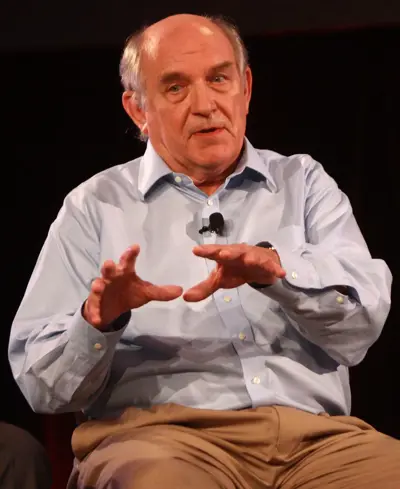
Charles Alan Murray is an American political scientist, writer, and public speaker. He is the W.H. Brady Scholar at the American Enterprise Institute, a conservative think tank in Washington, D.C.
