Herman Kahn Quotes
The objective of nuclear-weapons policy should not be solely to decrease the number of weapons in the world, but to make the world safer - which is not necessarily the same thing.
Kahn, Herman. Thinking About the Unthinkable in the 1980s. Simon and Schuster, 1984, p. 119.


Many politicians and military thinkers disagree with Kraus. America, England, France, Russia, and Israel have all demonstrated over the years that even with great provocation they would not resort to nuclear retaliation nor have they ever threatened use of WMDs. Iran, in contrast, has repeatedly stated as one of their major objective, the total destruction of another UN member state—Israel. Further, Iran has never possessed a weapon that it did not use shortly after possession, including poison gas. Therefore America and the United Nations have all determined that a double standard is necessary with Iran.


See {633890} regarding the nuclear accidents at that time.


This was his last publication. He died of a heart attack as the magazine was being printed. Since this was written one other possible use of nuclear weapons has been suggested—namely, retaliation for a biological attack. From a policy point of view, maintaining an arsenal of biological weapons for retaliatory purposes is dangerous and use for retaliation of biological weapons is not very controllable and arguably less humane than a nuclear weapon. His point however still holds. We have to have a national defense policy against many threats and we have to have defense policies that handle all these without nuclear tactics is insufficient to handle any of the threats without causing more problems and we have other weapons and techniques that are just as, if not more, effective. They and systems under development have the major role in our current defense policy.


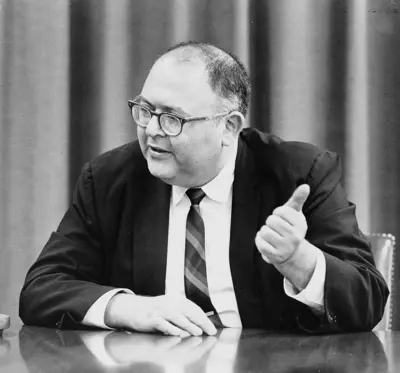
Herman Kahn was a founder of the Hudson Institute and one of the preeminent futurists of the latter part of the twentieth century. He originally came to prominence as a military strategist and systems theorist while employed at the RAND Corporation. He became known for analyzing the likely consequences of nuclear war and recommending ways to improve survivability, making him one of the historical inspirations for the title character of Stanley Kubrick's classic black comedy film satire Dr. Strangelove.
