Margaret Mead Quotes
The negative cautions of science are never popular.
Margaret Mead, 1901-1978, Anthropologist, Coming of Age in Samoa, 1928
Sourced by: Eigen's Political and Historical Quotations

The only soldier ever so honored

He made this quotation in a discussion about nuclear weapons, but the principle is valid for many areas from the Internet to pharmaceuticals. In the nuclear weapons case there have been a number of accidents – including fatal ones – over the years and on several occasions a nuclear weapon came close to detonating near populated areas. In one case, radiation damage from a crash of a nuclear weapons equipped bomber have made an area in Spain unusable for years into the future.


Under this initiative the US declassified and distributed technical, previously secret information, about atomic science to the world for scientific development. It has been very successful and there are few modern nations that have not benefitted from the program.

His wife also had a Doctorate in Chemistry—the 2nd woman to achieve that in Germany—and she was distraught that he had been the leading scientist developing not only the poison gas which the Germans introduced in WWI, but he also developed the tactics of use and personally went to the battlefield and supervised the first major gas attacks. This was much against the ethical value of most scientists and Jewish ethics in particular. Haber had been a close colleague of Albert Einstein and the Kaiser Wilhelm Institute, and while Einstein was trying to get scientists to sign a petition against the war, Haber was developing the first weapon of mass destruction. After Haber gave this response to his wife, we left to go to the front to supervise another major gas attack. His wife committed suicide. Haber, while a German national hero to militaristic Germany, never again had the kind of pre-war relationship that existed with Einstein and many other fellow scientists.

The Barbary Pirates had an incredible extortion racket going in the Mediterranean. If nations would pay them an annual sum each year, they would not attack and seize merchant ships of that country and sell the ships and goods while holding the sailors for ransom. American politicians were divided on whether to pay the ransom and an annual tribute or send a military force to try and extract the prisoners and bombard and “punish” the Barbary States for their piracy. While the Americans were debating the problem, Eaton thought that there was contempt for the weakness of America in much of North Africa and the Middle East, and the weakness caused more pirates to join and try and go after American vessels.

This unfortunately happens in Congress all the time. A good example is {640730}.


The Scientific Project that developed the Atomic Bomb. After the development of the atomic bomb there were great pressures on the involved scientists to downplay the dangers of nuclear weapons development. The weapons developer arm of the government was anxious not to frighten the public which might call for more oversight or even limitation of development and testing. Equally important was the scientists themselves who understood the forces that they had unleashed and were worried that if the public realized the worst of the possibilities, science and scientific research itself might be in jeopardy from a new Luddite reaction. Oppenheimer urged candor with the public. Most scientists took his advice but the Atomic Energy Commission had become politicized and when Oppenheimer went public with his and others scientific concerns they punished him by calling him a security risk and withdrawing his clearance thus cutting him off from new developments and discrediting him and his views at the same time.


At that time, most Republicans were ideologues and global warming and climate change did not fit their word view so mostly they ignored the science and attacked the scientists.
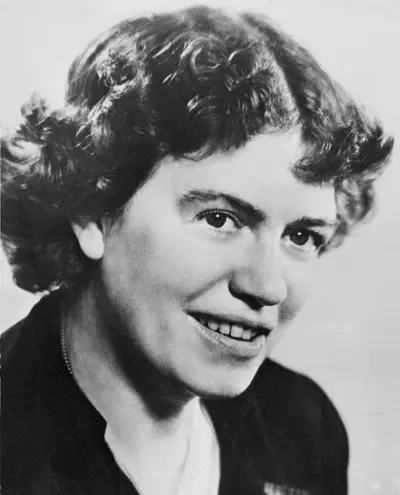
Margaret Mead was an American cultural anthropologist who featured frequently as an author and speaker in the mass media during the 1960s and 1970s. She earned her bachelor's degree at Barnard College in New York City and her MA and PhD degrees from Columbia University. Mead served as President of the American Association for the Advancement of Science in 1975.
