Isaac Newton Quotes
The motions which the planets now have could not spring from any natural cause alone, but were impressed by an intelligent Agent.
Newton, Isaac. Letter to Richard Bentley, 10 Dec. 1692. The Correspondence of Isaac Newton, edited by H.W. Turnbull, vol. 3, Cambridge UP, 1961, p. 234.


The Roman Catholic Church had stultified scientific thinking for over a thousand years where differing with accepted church doctrine was not only discouraged but was dangerous. Hicletas—see {590328}—realized that the earth rotated around its own axis three centuries before Christ, and his view was in the literature to which learned people had access. Copernicus later communicated this idea to the Pope but in much more delicate terms—see {590327}. He did not have the problems that Galileo endured with the Church for several reasons. There were different men controlling the church, the printing press had been invented and Galileo published a book that many could read, the Protestant Reformation had really frightened the Church fathers who felt more vulnerable and less tolerant.


Voltaire was also an amateur scientist and was familiar with the new physics of Newton. His mistress, was one of the best scientists in France and the translator of Newton into French. Voltaire marveled at the logic that drove the universe and assumed that there must have been a prime mover. At the same time, although believing in God, Voltaire, like many other intellectuals of the time, were major enemies of organized religion in general and the Catholic Church in particular. See {621191} .


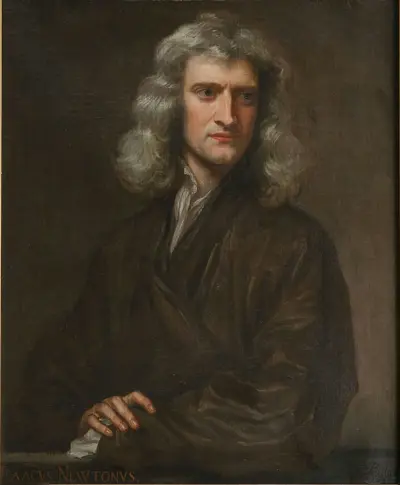
Sir Isaac Newton PRS was an English mathematician, physicist, astronomer, theologian, and author (described in his time as a "natural philosopher") who is widely recognised as one of the greatest mathematicians and most influential scientists of all time and as a key figure in the scientific revolution. His book Philosophiæ Naturalis Principia Mathematica (Mathematical Principles of Natural Philosophy), first published in 1687, established classical mechanics. Newton also made seminal contributions to optics, and shares credit with Gottfried Wilhelm Leibniz for developing the infinitesimal calculus.
