Horatio Nelson Quotes
... the most bold and daring act of the age.
The USS Philadelphia was a 1240-ton, 36-gun sailing frigate of the United States Navy which was sent to Tripoli in the First Barbary War. On October 31, 1803, she ran aground on an uncharted reef off Tripoli Harbor. Under fire from shore batteries and Tripolitan gunboats, Captain Bambridge had to surrender the crew and the ship, which was a far better vessel than any which the Barbary Pirates sailed. President Jefferson and the naval authorities believed that the Philadelphia should not be allowed to be repaired and serve Tripoli. Under the guise of a ship in distress in need of a place to tie up after having lost all anchors in a storm, on February 16, 1804 a volunteer assaulting party of officers and men under Lieutenant Stephen Decatur, Jr. boarded her from the ketch Intrepid and after making sure that she was not seaworthy burned her where she lay in Tripoli Harbor amidst the Tripolitan naval fleet, returned the Intrepid and escaped denying the enemy the use of a modern warship.
Horatio Nelson, 1758-1805, British Admiral, Statement when he received a report of the American Navy burning the Philadelphia Quoted in Joseph Wheelan, Jefferson’s War
Sourced by: Eigen's Political and Historical Quotations


On October 31, 1803, Tripolitan forces captured the ship Philadelphia and imprisoned the whole crew. The Pasha (provincial governor) of Tripoli, Yusef Karamanli demanded that the United States not only pay a ransom for the prisoners but an annual tribute to Tripoli.

Nearly two years after Tripoli had declared war against the United States, the U.S., after much deliberation, decided to stop negotiating a tribute settlement with Tripoli. The U.S. launched their attack on June 11, 1803 in what would be the first amphibious operation on the Barbary Coast. After witnessing the operation, the Pasha was unmoved. Piracy and war was a way of life for the Barbary states.

In the 18th Century, the Islamic Barbary States combined their religious beliefs for Jihad against non believers with a classic criminal enterprise. They would authorize cosairs to outfit ships and attack Christian merchant ships on the high seas. They would capture the ship and the cargo, which would be split with the ruler of the country. The crew and passengers would by “rented out” as slaves until they would be ransomed, the proceeds of which would also be shared. To motivate a larger ransom, the captives were regularly tortured as well as worked almost to death. The Barbary Pirates encouraged the “slaves” to write to their relatives, friends and governments to try and raise the ransom. O’Brien’s ship was captured in 1785. He had been a slave for 4 years when he wrote this. See {623704} for a quote from a letter he sent Congress. Finally, after 10 years, O’Brien and those of his crew that were still alive were finally freed. O’Brien’s unusual experience and knowledge of the Barbary States qualified him as an expert and he was then appointed Consul-General to Algiers. Individual Christian countries were offered a “treaty” whereby for an annual payment of tribute to the Barbary country, the corsairs of that country would not attack ships flying their flag. The Christian country had to make 4 different tribute payments to each of the Barbary nations. Most of the European powers were paying the tribute even though some could easily defeat the Corsair navies in a war. The cost of outfitting a fleet for war was much more costly than paying the tribute. The new nation of the United States was good pickings for the Barbary pilots and there was a period of several decades where the Americans had to create a policy to pay tribute or go to war. At different times America did both.
In the 18th Century, the Islamic Barbary States combined their religious beliefs for Jihad against non believers with a classic criminal enterprise. They would authorize cosairs to outfit ships and attack Christian merchant ships on the high seas. They would capture the ship and the cargo, which would be split with the ruler of the country. The crew and passengers would by “rented out” as slaves until they would be ransomed, the proceeds of which would also be shared. To motivate a larger ransom, the captives were regularly tortured as well as worked almost to death. The Barbary Pirates encouraged the “slaves” to write to their relatives, friends and governments to try and raise the ransom. O’Brien’s ship was captured in 1785. He had been a slave for 4 years when he wrote this. See for a quote from a letter he sent Congress. Finally, after 10 years, O’Brien and those of his crew that were still alive were finally freed. O’Brien’s unusual experience and knowledge of the Barbary States qualified him as an expert and he was then appointed Consul-General to Algiers. Individual Christian countries were offered a “treaty” whereby for an annual payment of tribute to the Barbary country, the corsairs of that country would not attack ships flying their flag. The Christian country had to make 4 different tribute payments to each of the Barbary nations. Most of the European powers were paying the tribute even though some could easily defeat the Corsair navies in a war. The cost of outfitting a fleet for war was much more costly than paying the tribute. The new nation of the United States was good pickings for the Barbary pilots and there was a period of several decades where the Americans had to create a policy to pay tribute or go to war. At different times America did both.

This was a very significant battle. The Barbary states had navies of corsairs who were very experienced in battle. The new United States barely had a navy and the Enterprise was just an armed schooner. When the Enterprise sighted the Tripoli, many in the crew thought that the American ship would run. The schooner was badly outgunned by the warship and just as badly outmanned. And the Tripoli sailors were battle hardened while the Americans had little battle experience. Yet Sterett not only attacked, but won one of the most one sided sea battles in which the United States has ever engaged. There were NO casualties for the Enterprise while half the Tripolitan crew was killed and the other half wounded. The Americans while not battle hardened were great sailors and they outmaneuvered the Tripoli and cut their rigging to pieces with very accurate gunnery. One reason that this quotation is so important is that it made the Americans realize that Americans could not only hold their own, but could defeat the Barbary corsairs even when outgunned and out manned. This created much confidence in President Jefferson and the other American leaders of the time. This Enterprise was the first of 4 American ships that would bear that name.

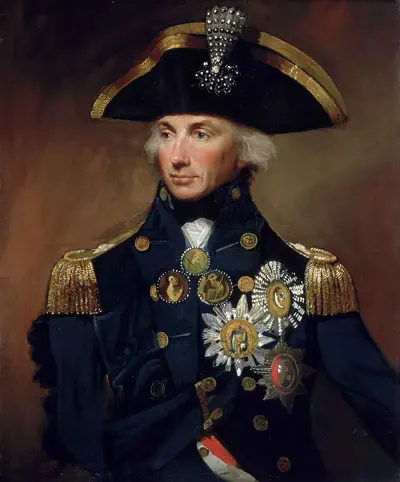
Vice-Admiral Horatio Nelson, 1st Viscount Nelson, 1st Duke of Bronté, KB, also known simply as Admiral Nelson, was an English flag officer in the Royal Navy. His inspirational leadership, grasp of strategy, and unconventional tactics brought about a number of decisive British naval victories, particularly during the Napoleonic Wars. He was wounded in combat, losing sight in one eye in Corsica at the age of 35, and most of one arm in the unsuccessful attempt to conquer Santa Cruz de Tenerife when he was 38. He was fatally shot at the Battle of Trafalgar in 1805.
