Ron Paul Quotes
The moral and constitutional obligations of our representatives in Washington are to protect our liberty, not coddle the world, precipitating no-win wars, while bringing bankruptcy and economic turmoil to our people.
Ronald E. Paul, U.S. Congressman (Republican, TX), Libertarian Nominee for President, 1987
Sourced by: Eigen's Political and Historical Quotations


This was his political speech about the importance of the state militia. However, in the War of 1812 in September the British attacked and burned the town of Portland which the militia feebly tried to defend. See his private view then: {613332}.


Vidal, a staunch liberal held this view along with many ultra conservatives end extreme liberals. The constitution requires the Congress to declare war, but they have not done so for any of the wars since WWII. The President assumed the war power. And the only coherent budgets began.


Jefferson and many others thought the original drafting of the Constitution was deficient in not explicitly protecting rights from the government. See {586024}. When it came time for ratification, it was clear that ratification would not take place unless that was remedied and the Bill of Rights made the ratification possible by satisfying many critics of whom Jefferson was but one. Note that the protection sought was from the President and the Congress.


Hitler ridiculed the letter after receiving it in public speech.


John Adams wrote the draft.

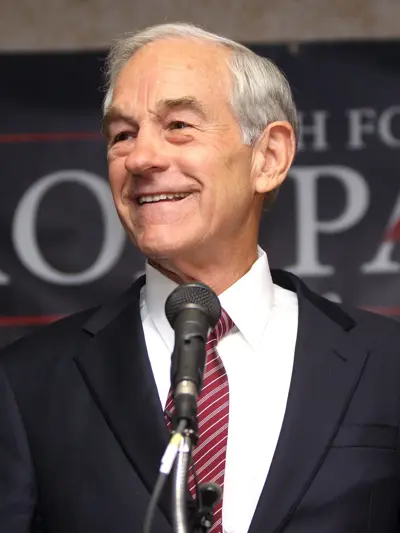
Ronald Ernest Paul is an American author, physician, and retired politician who served as the U.S. Representative for Texas's 22nd congressional district from 1976 to 1977 and again from 1979 to 1985, and for Texas's 14th congressional district from 1997 to 2013. On three occasions, he sought the presidency of the United States: as the Libertarian Party nominee in 1988 and as a candidate for the Republican Party in 2008 and 2012. A self-described constitutionalist, Paul is a critic of the federal government's fiscal policies, especially the existence of the Federal Reserve and the tax policy, as well as the military–industrial complex, the war on drugs, and the war on terror. He has also been a vocal critic of mass surveillance policies such as the USA PATRIOT Act and the NSA surveillance programs. He was the first chairman of the conservative PAC Citizens for a Sound Economy, a free-market group focused on limited government, and has been characterized as the "intellectual godfather" of the Tea Party movement, a fiscally conservative political movement that is largely against most matters of interventionism.
