Winston Churchill Quotes
The moment approaches when we shall no longer be able to pay cash for shipping and other supplies.... I believe that von will agree that it would be wrong in principle and mutually disadvantageous in effect, if at the height of this struggle, Great Britain were to be divested of all saleable assets so that after victory was won with our blood, civilization saved, and time gained for the United States to be fully armed against all eventualities, we should stand stripped to the bone. Such a course would not be in the moral or economic interests of either of our countries.... You may be assured that we shall prove ourselves ready to suffer and sacrifice to the utmost for the Cause, and that we glory in being its champion. The rest we leave to you and to your people, being sure that ways and means will be found which future generations on both sides of the Atlantic will approve and admire.
Roosevelt came up with Lend Lease and other mechanisms to provide military aid to England.
Winston Churchill, 1874-1965, British Prime Minister (Conservative), Communiqué to Franklin D. Roosevelt, 1941
Sourced by: Eigen's Political and Historical Quotations

The president had wanted to send large amounts of armament and other material to England—Lend Lease—to help stave off a German invasion. The leading military men argued against it. Conservative isolationists and Congress had prevented our own military from having enough supplies and equipment. Also the conclusion of the American military leadership of the time was that England was beyond help and would have to capitulate to Germany. Even with massive armaments they would not be able to defend themselves. Any arms that we might provide to England would then fall into German hands. Roosevelt then sent his civilian assistant, Harry Hopkins, to England to assess their ability to survive. Hopkins with no military experience told Roosevelt that with the arms and ammunition England would be able to forestall invasion. Roosevelt trusted Hopkins’ judgment and decided to arm England. Hopkins turned out to be exactly correct and the military leadership was wrong. See {642830}.


FDR’s attempt to cap WWII income with any excess going to pay for the war failed as the wealthy in the country pulled out “all the stops” to defeat the proposal. Roosevelt was able, however, to get a maximum tax bracket of 88 percent on all income over $200,000 which was less onerous to the very rich but still terrible. They could not defeat that proposal.

The President was arguing for a large budgetary increase for the Defense Department.


Precursor to CIA. WWII had begun in Europe and England was under great pressure as Hitler threatened invasion and the German military had been successful everywhere they tried to invade. FDR had received an intelligence report and advice from our Ambassador to England, Joseph P. Kennedy (JFK’s father). He told the military, the State Department, and the President that England was finished—that they would not be able to stave off the coming German invasion. He predicted that Germany would set up a puppet state. Any help America could supply would not only be wasted but if material, would fall into the hands of the Nazis and be used against us. {610109} The military attaches attached to our Embassy in England generally agreed. However, the President knew that not only did Kennedy dislike Winston Churchill {613151}, but he had been an admirer not only of German Fascism, but Hitler in particular. Kennedy ran around with some of the wealthy, aristocratic English Fascists who were advocating a negotiated surrender to prevent English civilian casualties. So FDR sent his friend, Donavan, to make an independent Assessment. Donovan had served as an officer in WWI and had earned the Medal of Honor. This quotation was the summary of Donovan’s recommendation. Based on Donovan’s report, and other information, the president had gathered and his geopolitical judgment, FDR provided aid to England (Lend Lease) and fired Kennedy, who had disliked Roosevelt before and this turned to hate and became a vendetta for Kennedy thereafter, especially when his oldest son Joe volunteered to serve in the war, that the Ambassador had so viciously opposed, {610121} and then was killed while carrying out a very dangerous volunteer mission. {616651}.


Chamberlain did indeed resign. Churchill replaced him as Britain’s wartime Prime Minister.

Assigned to the Treasury Department to create war bond posters


Expressing concern over the amount of lend-lease and other aid going to England:
Referring to women in the United States armed forces:

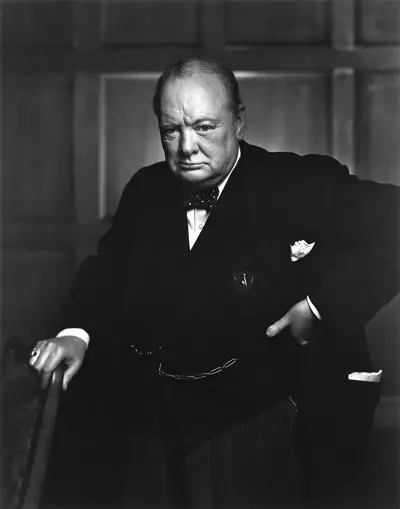
Sir Winston Leonard Spencer Churchill, KG, OM, CH, TD, DL, FRS, RA was the Prime Minister of the United Kingdom from 1940 to 1945, during the Second World War, and again from 1951 to 1955. Apart from two years between 1922 and 1924, Churchill was a Member of Parliament (MP) from 1900 to 1964 and represented a total of five constituencies. Ideologically an economic liberal and imperialist, he was for most of his career a member of the Conservative Party, as leader from 1940 to 1955. He was a member of the Liberal Party from 1904 to 1924. Churchill was also well known for his military career and as a historian, painter and writer, and among his many awards was the Nobel Prize in Literature.
