George Orwell Quotes
The majority of pacifists either belong to obscure religious sects or are simply humanitarians who object to the taking of life and prefer not to follow their thoughts beyond that point. But there is a minority of intellectual pacifists whose real though unadmitted motive appears to be hatred of western democracy and admiration of totalitarianism. Pacifist propaganda usually boils down to saying that one side is as bad as the other, but if one looks closely at the writings of younger intellectual pacifists, one finds that they do not by any means express impartial disapproval but are directed almost entirely against Britain and the United States. Moreover they do not as a rule condemn violence as such, but only violence used in defence of western countries. The Russians, unlike the British, are not blamed for defending themselves by warlike means, and indeed all pacifist propaganda of this type avoids mention of Russia or China.
Sourced by: Eigen's Political and Historical Quotations


See {611241}, {611246}, {611442}. While the issues with Cromwell were essentially political, there were substantial theological and cultural issues between the Quakers and other protestant sects which even extended across to the New World. See {612011}


To support the war effort, the most militant suffragettes ceased anti Government militancy. The suffragette movement was split by WWI and the issue of pacifism. See {621266} for the anti-war factional view.

He used the “united nations” as a general description as the UN had not been created or named yet, However, as this quotation demonstrates, the President was already thinking about a UN idea, but as a realist, he explained that the great powers had to come to some agreement of interests. Actually China and France, at the time, would go along with whatever the United States and Britain wanted to do and had a great common interest, and there was already a strong association of interests between Britain and America. Russia was to be the problem and a complete common interest was never to be, but there was enough to get the United Nations started.


He was the son of LeRoy Percy a Governor of Mississippi, who was running for that post against James Kimble Vardaman, an unabashed Racist, populist, and hate-monger. (See the related quotes for examples.) He appealed to the worst of the Mississippi. This was his famous description of the crowd that turned out for a Vardaman rally in 1903,
_0_thumbnail_47x47.jpg)
He was countering the argument of unlimited free speech advocates that fascist hate speech should not be countered by more speech on teh other side. Historically, he observed, that Fascism has only been defeated by force and control.


The writer was born and brought up a Muslim and because he criticizes Islam, he has had a death fatwa issued against him much like Salman Rushdie.


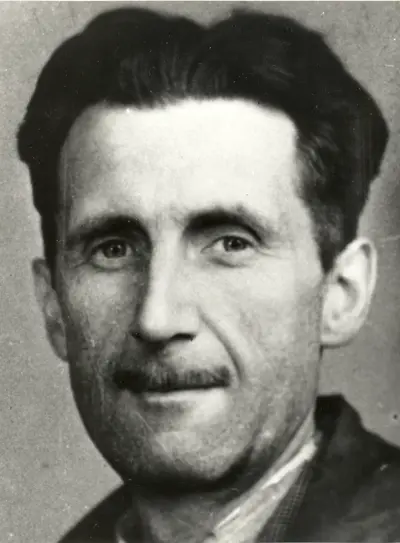
Eric Arthur Blair, known by his pen name George Orwell, was an English novelist, essayist, journalist and critic. His work is characterised by lucid prose, biting social criticism, opposition to totalitarianism, and outspoken support of democratic socialism.
