Mary Robinson Quotes
The international human rights framework is a vital component and engine for promoting global values. Governments have signed up to this international legal framework and we should hold them accountable, in all circumstances from environmental or labour standards, to trade talks, arms control and security issues as well as other international legal codes.
Robinson, Mary. A Voice for Human Rights. Edited by Kevin Boyle, University of Pennsylvania Press, 2006.


During the 2006 War on Terror, the George W. Bush Administration established secret prisons in friendly countries where suspected terrorists could be housed and questioned without regard to the American laws and regulations—or even Presidential directives about torture. The prisons were on the soil and under the jurisdiction of foreign countries whose laws were not as respectful of human rights and the rule of law as ours. Therefore the administration could deny that the U. S. was responsible for what occurred even though we secretly transported the suspects to the secret prisons and American agents participated in their “interrogation.”

Prior to that the accepted phrase was “Law of Nations,” but soon after Bentham first used “International Law” it caught on and became widespread in the English Language. See Columbia Law Review, Vol. 5, No. 2, February 1905

The Senate was debating a law to make torture of foreigners and captives illegal under all circumstances. Vice President Cheney was very strongly opposed wanting an exception made for the CIA.

The speech is traditionally written by the government.


The United States Senate must ratify all treaties before they can become effective. The Senate has been very reluctant to ratify treaties where the U. S. government or any of its citizens could come under the jurisdiction of any legal entity which did not abide by all the rights citizens are guaranteed by the U. S. Constitution. As a result, we do not recognize the World Court and the Treaty of Rome for example. The latter is the one that gives the World Court jurisdiction over a high level official who commits war crimes even in his own country. The result is that many dictators who do not want to be constrained by international law, do not sign the treaty fending off any pressure to do so by pointing to the United States. But Rothkopf and others who agree with him have not yet been able to come up with a mechanism that will assure American Constitutional rights to Americans who might be involved with the World Court and allow the court to punish the dictators who abuse their own population. The French would like their laws and constitution to control. The Russians, theirs. The Chinese, theirs. Every American public official takes an oath to defend The Constitution. That is their primary duty. Foreign policy and punishing international war criminals must take a lower priority.
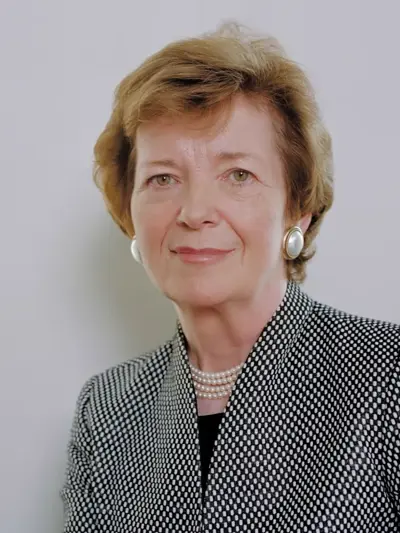
Mary Therese Winifred Robinson is an Irish independent politician who served as the seventh President of Ireland from December 1990 to September 1997, becoming the first woman to hold this office. She also served as United Nations High Commissioner for Human Rights from 1997 to 2002 and a Senator for the University of Dublin from 1969 to 1989. She first rose to prominence as an academic, barrister and campaigner. She defeated the Fianna Fáil party's Brian Lenihan and the Fine Gael party's Austin Currie in the 1990 presidential election, becoming the first Independent candidate nominated by the Labour Party, the Workers' Party and Independent Senators. She was the first elected President in the office's history not to have had the support of Fianna Fáil.
