John Quincy Adams Quotes
The highest glory of the American Revolution was this: it connected in one indissoluble bond the principles of civil government with the principles of Christianity.


Although the Puritans were the first religious group of immigrants who came to America for religious freedom, once the obtained it, they were terribly despotic in trying to force others to adopt their religious views. By seeking religious freedom the planted the seeds of democracy. By denying it to others, they also planted the seed of the First Amendment. Those who insisted upon separation of church and state always cited the Puritans as example one of what can happen with an established church in America.


Williams was the first theologian who not only advocated religious toleration but argued that Christianity demanded it and the separation of church and state.

Abdul Rahman, Afghan citizen, had converted from Islam to Christianity 16 years before. Conversion from Islam is a capital crime under Sharia Law which was the law of Afghanistan even after the Taliban had been overthrown. He was jailed and threatened with death. Statements like this and others made directly to the government persuaded the Afghan politicians to go against their mullahs who demanded the death penalty as is proscribed by Islamic Law—Sharia. The judges tried to get Rahman to recant and he would not (see {589518}). So they finally decided that he must be mentally insane and therefore could not be tried, and the problem was solved that way.

The Mormons were the most persecuted religion in American History and have a keen appreciation for the importance of upholding Constitutional Rights.


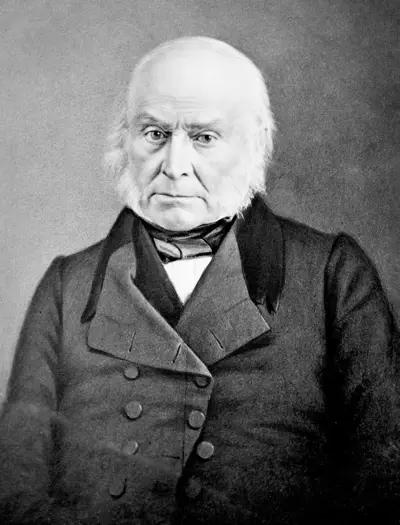
John Quincy Adams was an American statesman, diplomat, lawyer, and diarist who served as the sixth president of the United States, from 1825 to 1829. He previously served as the eighth United States Secretary of State from 1817 to 1825. During his long diplomatic and political career, Adams also served as an ambassador, and as a member of the United States Senate and House of Representatives representing Massachusetts. He was the eldest son of John Adams, who served as the second U.S. president from 1797 to 1801, and First Lady Abigail Adams. Initially a Federalist like his father, he won election to the presidency as a member of the Democratic-Republican Party, and in the mid-1830s became affiliated with the Whig Party.
