Seamus Heaney Quotes
The Heaneys were aristocrats, in the sense that they took for granted a code of behavior that was given and unspoken. Argumentation, persuasion, speech itself, for God's sake, just seemed otiose and superfluous to them.
Heaney, Seamus, and Dennis O'Driscoll. Stepping Stones: Interviews with Seamus Heaney. Farrar, Straus and Giroux, 2008.


No other religion has ever preached majority rule so clearly and unambiguously. Because of this strong democratic philosophy, some dictatorial governments see the Bahai as particularly dangerous. Also some religions who see their doctrine and the world of God as being always right and the majority of people should not determine morality are even law. They recognize a higher power. Iran, in particular, has been a terrible persecutor of Bahai, their largest religious minority, which is the antithesis to the concept of a theocracy and at the opposite end of the religious spectrum from Islam. Bahai leaders had been executed. Bahai there are not allowed to attend higher education institutions, build religious facilities, preach openly or serve in many roles. See {614912}.
Chivalry was a set of rules that regulated the behavior of knights especially as to their behavior in battle. It was the Medieval equivalent of the Geneva Convention. At the time knights fought against knights and peasants fought against peasants. After time the fighting was mixed. Previously, if a knight was subdued by other knights, he would surrender and promise to fight any more and that would be honored. But when a small group of peasants brought down a knight in armor, he could not surrender. He had probably killed other lightly armored peasants who were friends, and the peasants did not trust the knights. So typically, the peasants just killed the fallen knight. Social class determined the concepts of honor, fairness, trust, and chivalry came to an end.


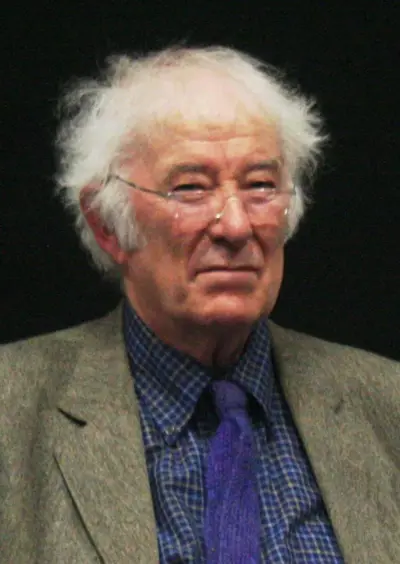
Seamus Justin Heaney MRIA was an Irish poet, playwright and translator. He received the 1995 Nobel Prize in Literature. Among his best-known works is Death of a Naturalist (1966), his first major published volume. Heaney was and is still recognised as one of the principal contributors to poetry in Ireland during his lifetime. American poet Robert Lowell described him as "the most important Irish poet since Yeats", and many others, including the academic John Sutherland, have said that he was "the greatest poet of our age". Robert Pinsky has stated that "with his wonderful gift of eye and ear Heaney has the gift of the story-teller." Upon his death in 2013, The Independent described him as "probably the best-known poet in the world".
