Robert Kennedy Quotes
The Gross National Product - if we judge the United States of America by that - that Gross National Product counts air pollution and cigarette advertising, and ambulances to clear our highways of carnage. It counts special locks for our doors and the jails for the people who break them. It counts the destruction of the redwood and the loss of our natural wonder in chaotic sprawl. It counts napalm and counts nuclear warheads and armored cars for the police to fight the riots in our cities… Yet the gross national product does not allow for the health of our children, the quality of their education or the joy of their play. It does not include the beauty of our poetry or the strength of our marriages, the intelligence of our public debate or the integrity of our public officials. It measures neither our wit nor our courage, neither our wisdom nor our learning, neither our compassion nor our devotion to our country, it measures everything in short, except that which makes life worthwhile.
Robert F. Kennedy, 1925-1968, U.S. Senator (Democrat, NY), U.S. Attorney General, Speech, University of Kansas, March 18, 1968
Sourced by: Eigen's Political and Historical Quotations


He did adopt a program of extensive building of apartments, schools, hospitals and other infrastructure. But the nation was in a virtual dictatorship of him and his wife with little regard for human rights. The rapid steding on construction was then followed by his program of austerity in which food became so scarce that malnutrition was common and many were at the verge of starvation to pay his programs. He and his wife were convicted at a show trial and executed immediately afterward.

Many of the Taliban leadership attended this Madrassa when young including Mullah Omar, the leader of the Taliban. Haq is often called “Father of the Taliban.”


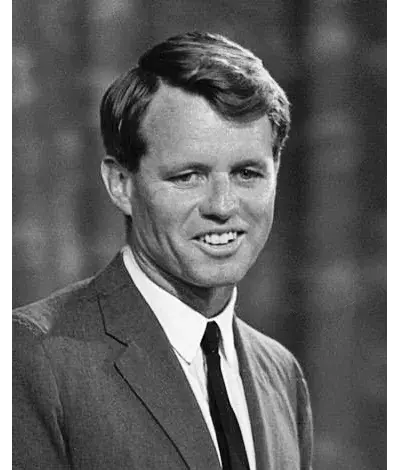
Robert Francis Kennedy, also referred to by his initials RFK or by the nickname Bobby, was an American politician and lawyer who served as the 64th United States Attorney General from January 1961 to September 1964, and as a U.S. Senator from New York from January 1965 until his assassination in June 1968. He was, like his brothers John and Edward, a prominent member of the Democratic Party and has come to be viewed by some historians as an icon of modern American liberalism.
