Adam Smith Quotes
The greatest improvement in the productive powers of labour, and the greater part of the skill, dexterity, and judgment with which it is anywhere directed, or applied, seem to have been the effects of the division of labour.
Smith, Adam. An Inquiry into the Nature and Causes of the Wealth of Nations. W. Strahan and T. Cadell, 1776.


This is a classic illustration of a quotation illustrating the problem that political discussions have with the issue of causality. Conrad is absolutely correct in stating that investment and innovation as the direct cause for most productivity. However, without the demand created by consumption (or the prospect of it) there will be little capital and effort at innovation. There is a causal chain and different ideological proponents argue for their preferred link in the chain tending to ignore the other links. Many liberals tout increasing consumption and pay little attention to the investment and innovation—an error of the opposite of Conrad’s.


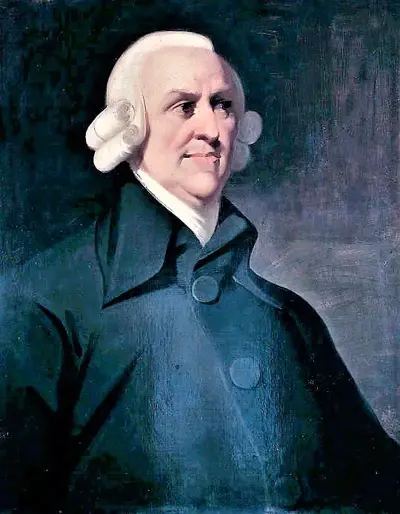
Adam Smith FRSA was a Scottish economist, philosopher as well as a moral philosopher, a pioneer of political economy, and a key figure during the Scottish Enlightenment, also known as ''The Father of Economics'' or ''The Father of Capitalism''. Smith wrote two classic works, The Theory of Moral Sentiments (1759) and An Inquiry into the Nature and Causes of the Wealth of Nations (1776). The latter, often abbreviated as The Wealth of Nations, is considered his magnum opus and the first modern work of economics. In his work, Adam Smith introduced his theory of absolute advantage.
