Milton Friedman Quotes
The free man will ask neither what his country can do for him nor what he can do for his country. He will ask rather 'What can I and my compatriots do through government' to help us discharge our individual responsibilities, to achieve our several goals and purposes, and above all, to protect our freedom?
Friedman, Milton. Capitalism and Freedom. University of Chicago Press, 1962, p. 2.


The fundamental conflict in many societies is between whether freedom is absolute with all entitled or whether some can determine for others whether they can use their freedom “appropriately.”


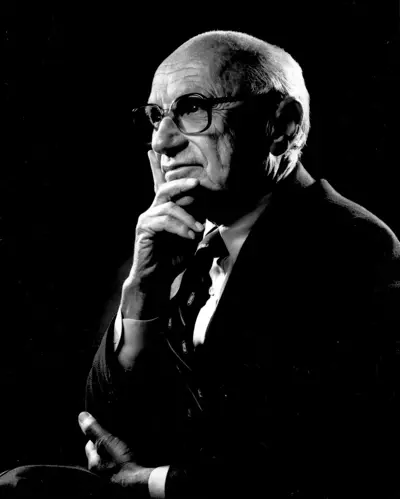
Milton Friedman was an American economist and statistician who received the 1976 Nobel Memorial Prize in Economic Sciences for his research on consumption analysis, monetary history and theory and the complexity of stabilization policy. With George Stigler and others, Friedman was among the intellectual leaders of the Chicago school of economics, a neoclassical school of economic thought associated with the work of the faculty at the University of Chicago that rejected Keynesianism in favor of monetarism until the mid-1970s, when it turned to new classical macroeconomics heavily based on the concept of rational expectations. Several students and young professors who were recruited or mentored by Friedman at Chicago went on to become leading economists, including Gary Becker, Robert Fogel, Thomas Sowell and Robert Lucas Jr.
