William Graham Sumner Quotes
The Forgotten Man is delving away in patient industry, supporting his family, paying his taxes, casting his vote, supporting the church and the school, reading his newspaper, and cheering for the politician of his admiration, but he is the only one for whom there is no provision in the great scramble and the big divide. Such is the Forgotten Man. He works, he votes, generally he prays — but he always pays — yes, above all, he pays.
Sumner, William Graham. The Forgotten Man and Other Essays. Edited by Albert Galloway Keller, Yale University Press, 1918, p. 491.


“The Forgotten Man” became a commonly used political phrase at the end of the 19th century after he wrote this.


At the time there were tax breaks for large yachts but not for small boats that a middle class person might own. It was another example of the tax laws at the time where the poor paid only Social Security taxes, and the rich lobbied for an got very large tax breaks and subsidies and hence the burden was carried by an increasingly stressed middle class and by cuts in services to the needy. The companies that made the yachts also supported the tax breaks as did the unions and workers in the industry. See {624985}. .

This was written in the early years of the Great Depression. Over 25 percent of Americans were out of world. The stock market had crashed and many banks failed wiping out family savings where there was any. Social Security, Bank and Stock Market Regulations were not yet passed. The New Deal government was just starting creating jobs, but there was great concern that the capitalistic system had failed. Thomas and other critics were right that the U. S. Government had not before used its machinery for “ease and security of living”; they called for the adoption of state socialism. President Roosevelt however instead reformed American capitalism by adding substantial regulation, provided direct relief to the unemployed poor, stimulated the economy, created Social Security, Federal Deposit Bank Insurance, unemployment insurance and initiated massive public works programs. It took almost a decade but American Capitalism was saved and transformed to the greatest industrial output and standard of living increase the world had known. It was not until 2008 that the capitalistic American economy melted down again. Regulation of corporations had diminished. The banks failed and had to be bailed out again but as the result of Social Security, Unemployment Insurance and other programs there was some cushioning of the effect of the Great Recession. The middle and lower class insecurity was back along with the wealthy taking a much larger proportion of the national wealth. The big difference was that few called for an end to capitalism and the political debate was on how best to fix the weaknesses of capitalism. Even most socialists around the world had built their Social Democracies around a capitalistic economic structure.


He was responding to the Democratic Slogan, “You never had it so good.” Over 50 years later the Democrats would be lamenting the Republican administration of George W. Bush for the huge debt and the fighting of the war in Iraq. This quotation is an excellent illustration of the fact that the two American political parties “flip-flop” positions over time to accommodate whether they are governing or in opposition. By 2005, the Republicans were in support of high deficits as they had produced the largest debt in American History. In the 1950s, Republican doctrine was to condemn all government deficits. And Republicans were the party of peace and the democrats were more aggressive in foreign policy. 50 years later, it was the Democrats calling for an end to the fighting (Iraq) and the Republicans supporting the war. Over the same period, the other two issues, taxes and inflation are still republican issues.

See {34743} or {33971} for a more colorful and eloquent statement of the same notion.


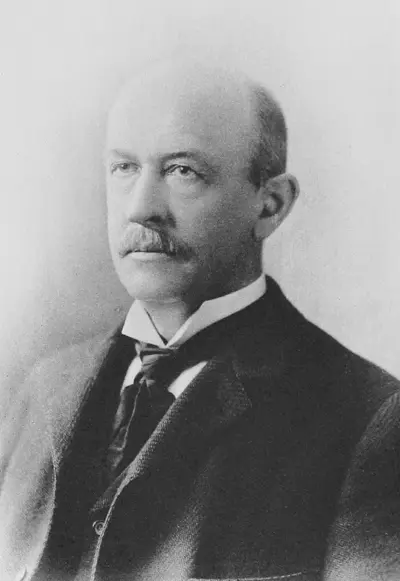
William Graham Sumner was a classical liberal American social scientist. He taught social sciences at Yale, where he held the nation's first professorship in sociology. He was one of the most influential teachers at Yale or any other major school. Sumner wrote widely within the social sciences, with numerous books and essays on American history, economic history, political theory, sociology, and anthropology. He supported laissez-faire economics, free markets, and the gold standard. He adopted the term "ethnocentrism" to identify the roots of imperialism, which he strongly opposed, and as a spokesman against it he was in favor of the "forgotten man" of the middle class, a term he coined. He had a long-term influence on conservatism in the United States.
