Karl Marx Quotes
The first requisite for the people's happiness is the abolition of religion.
Karl Marx, 1818-1883, German Economist & Socialist, 1844
Sourced by: Eigen's Political and Historical Quotations


In an interview with a Norwegian magazine, the Eco stated that he had based his novel, “Foucault’s Pendulum”, on Chesterton’s epigram: “When men stop believing in God, they don’t believe in nothing, they believe in anything.” See related quote.


The choice of non-capitalization of the word “god” was Jefferson’s and is retained herein. This quotation is one of the most important in American history because it set the boundary for when it was proper for government to legislate personal behavior. For Jefferson, legislation was only justified if the behavior damged other people economically or physicly. Moral, religious, ethical or cultural affects were not sufficient to interfere with other people's freedom. The quotation was initially given to argue against a state etablished church and blasphemy laws and has been used in arguments even into the 21st century debate over gay marriage.

Pen name: Jack Nipps


This is a critical quotation on the government establishment of religion issue. There are a few people who have argued over the years that the Founding Fathers and their culture was religious and where they were careful to avoid favoring one religion over another, they did NOT intend to put atheism on the same equal plane as religion as far as government action is concerned. However, some of the Founding Fathers were atheists, and some others like John Adams were deists—they believed in a God but not in the Trinity or in Judaism or any organized religion. So this quotation makes it clear that the First Amendment does NOT favor religion over non religion or secularism. Atheism must be on an equal footing but not on a higher plane.


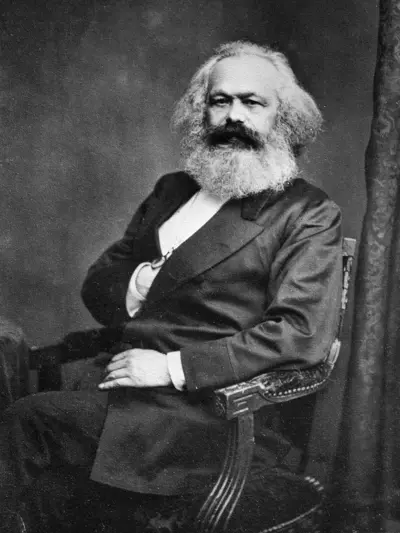
Karl Heinrich Marx was a German philosopher, economist, historian, sociologist, political theorist, journalist and socialist revolutionary. Born in Trier, Germany, Marx studied law and philosophy at university. He married Jenny von Westphalen in 1843. Due to his political publications, Marx became stateless and lived in exile with his wife and children in London for decades, where he continued to develop his thought in collaboration with German thinker Friedrich Engels and publish his writings, researching in the reading room of the British Museum. His best-known titles are the 1848 pamphlet The Communist Manifesto and the three-volume Das Kapital (1867–1883). Marx's political and philosophical thought had enormous influence on subsequent intellectual, economic and political history. His name has been used as an adjective, a noun, and a school of social theory.
