Ron Paul Quotes
The Fed has one power that is unique to it alone: it enables the creation of money out of thin air. Sometimes it makes vast new amounts. Sometimes it makes lesser amounts. The money takes a variety of forms and enters the system in various ways. And the Fed does this through techniques such as open-market operations, changing reserve ratios, and manipulating interest rates, operations that all result in money creation.
Paul, Ron. End the Fed. Grand Central Publishing, 2009, p. 55.


Prior to that the practice of the Fed was simply to make interest rate and other decisions and never discuss or explain anything. And they never tried to use words to try and change economic behavior. See {639156} for the Fed Chairman’s practice. However in 2001 that changed and they used language to shape investor and consumer behavior.


The ‘Fed’ refers to the Federal Reserve Board, the strength of which lies in its independence from politics. Some, however, believe that there should not be any entity that performs a major function in our society which is not accountable to the Executive Branch or the Congress or both.

This is an oft quoted statement because of the Great Depression which occurred the following year after Strong had passed away. The Federal Reserve followed the lead of President Hoover and did nothing while they watched the nation’s money supply shrink a third over the next 3 years, making a business comeback very difficult. If Strong had lived longer, he might have persuaded the others to increase the money supply and act as the nation’s safety valve. As the President of the New York Bank, he was the first among equals.

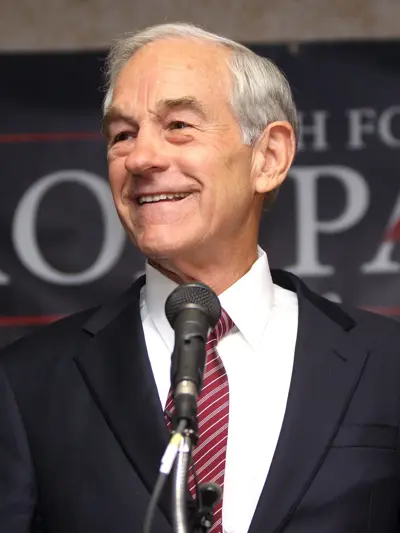
Ronald Ernest Paul is an American author, physician, and retired politician who served as the U.S. Representative for Texas's 22nd congressional district from 1976 to 1977 and again from 1979 to 1985, and for Texas's 14th congressional district from 1997 to 2013. On three occasions, he sought the presidency of the United States: as the Libertarian Party nominee in 1988 and as a candidate for the Republican Party in 2008 and 2012. A self-described constitutionalist, Paul is a critic of the federal government's fiscal policies, especially the existence of the Federal Reserve and the tax policy, as well as the military–industrial complex, the war on drugs, and the war on terror. He has also been a vocal critic of mass surveillance policies such as the USA PATRIOT Act and the NSA surveillance programs. He was the first chairman of the conservative PAC Citizens for a Sound Economy, a free-market group focused on limited government, and has been characterized as the "intellectual godfather" of the Tea Party movement, a fiscally conservative political movement that is largely against most matters of interventionism.
