Charles Darwin Quotes
The expression often used by Mr. Herbert Spencer of the Survival of the Fittest is more accurate, and is sometimes equally convenient.
Darwin, Charles. On the Origin of Species by Means of Natural Selection. 5th ed., John Murray, 1869, p. 91.


The concept of evolution did not occur suddenly only with Charles Darwin. Over 2000 years before Greek Philosophers had speculated about the basic concept of evolution. Later Leibniz discussed man’s ascendancy from apes well before Darwin. See {589927}.
Even today many people find Darwin’s views wanting because of the struggle and survival of the fittest concept implying that all creatures physically battle for survival and existance. But as this quotation illustrated, this was and is a very narrow view of Darwin’s concept of the struggle. Creatures fighting with each other is only a small part of this struggle. Larger parts are adapting to changed climate, versatility in food selection and extremely important a successful breeding pattern. The Thompson’s Gazelle is the most eaten animal on the African plains, and has virtually no defenses, but is an amazing breeder, with the shortest period of gestation of any mammal and the number of pregnancies per year. This little antelopes are thriving while they are eaten by most predators while the Lion, the strongest predator whom no animal will threaten, is becoming extinct.


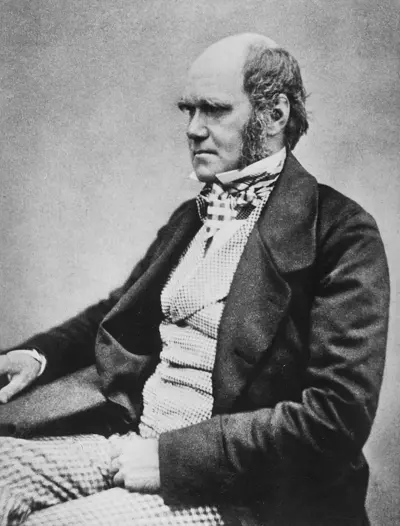
Charles Robert Darwin FRS FRGS FLS FZS was an English naturalist, geologist and biologist, best known for his contributions to the science of evolution.[I] His proposition that all species of life have descended over time from common ancestors is now widely accepted, and considered a foundational concept in science. In a joint publication with Alfred Russel Wallace, he introduced his scientific theory that this branching pattern of evolution resulted from a process that he called natural selection, in which the struggle for existence has a similar effect to the artificial selection involved in selective breeding. Darwin has been described as one of the most influential figures in human history, and he was honoured by burial in Westminster Abbey.
