Aristotle Quotes
The error of Socrates must be attributed to the false notion of unity from which he starts. Unity there should be, both of the family and of the state, but in some respects only. For there is a point at which a state may attain such a degree of unity as to be no longer a state, or at which, without actually ceasing to exist, it will become an inferior state, like harmony passing into unison, or rhythm which has been reduced to a single foot. The state, as I was saying, is a plurality which should be united and made into a community by education
Aristotle. Politics. Translated by Benjamin Jowett, Clarendon Press, 1885, p. 35.


Referring to the Public School System:


Explaining his practice of not engaging in public debate over historical policies and disagreements that occurred when he was in office:


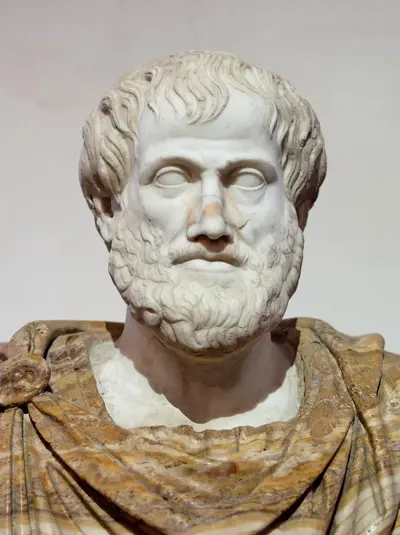
Aristotle (/ærɪˈstɒtəl/; Greek: Ἀριστοτέλης Aristotélēs, pronounced [aristotélɛːs]; 384–322 BC) was a Greek philosopher and polymath during the Classical period in Ancient Greece. Taught by Plato, he was the founder of the Lyceum, the Peripatetic school of philosophy, and the Aristotelian tradition. His writings cover many subjects including physics, biology, zoology, metaphysics, logic, ethics, aesthetics, poetry, theatre, music, rhetoric, psychology, linguistics, economics, politics, meteorology, geology and government. Aristotle provided a complex synthesis of the various philosophies existing prior to him. It was above all from his teachings that the West inherited its intellectual lexicon, as well as problems and methods of inquiry. As a result, his philosophy has exerted a unique influence on almost every form of knowledge in the West and it continues to be a subject of contemporary philosophical discussion.
