Arthur Henderson Quotes
The drive toward economic nationalism is only part of the general revival of nationalism.
Henderson, Arthur. "Essential Elements of a Universal and Enduring Peace." Nobel Lecture, 11 Dec. 1934, Oslo. Nobel Lectures, Peace 1926-1950, edited by Frederick W. Haberman, Elsevier Publishing Company, 1972.


The Country was still in the Depression.


This seems to be origin of the slogan that was used by the extreme right wing opponents of fighting Hitler in WWII and an isolationist minor political party that formed in 1944.


Buchanan was the first major Republican to advocate isolationism since that was the backbone of Republican Party ideology in the decades before WWII. This was a large reversal from the Internationalism and Manifest Destiny of Republicans under Presidents McKinley and Theodore Roosevelt. After Roosevelt’s great leadership making the United States the preeminent power in the World, the Republicans also espoused that direction and even took it further than the Democrats. But Buchanan was advocating another Republican Flip Flop, and while he found little support from Republican Party regulars, he fired up a small but intense group—most;y white males who were not college graduates. These Buchanan supporters became the nucleus of the Tea Party that would come to prominence 20 years later.


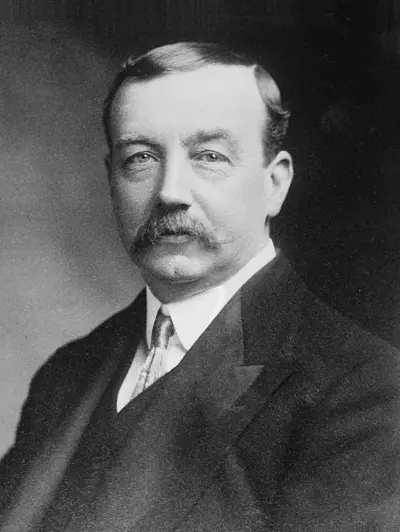
Arthur Henderson was a British iron moulder and Labour politician. He was the first Labour cabinet minister, won the Nobel Peace Prize in 1934 and, uniquely, served three separate terms as Leader of the Labour Party in three different decades. He was popular among his colleagues, who called him "Uncle Arthur" in acknowledgement of his integrity, his devotion to the cause and his imperturbability. He was a transitional figure whose policies were, at first, close to those of the Liberal Party. The trades unions rejected his emphasis on arbitration and conciliation, and thwarted his goal of unifying the Labour Party and the trade unions.
