John Calvin Quotes
The doctrine of free will is always in danger of robbing God of his honor
John Calvin, 1509-1564, Lawyer and Protestant Minister, Founder of Calvinism, Institutes of the Christian Religion
Sourced by: Eigen's Political and Historical Quotations


By morally subjugating the existing laws, the scriptures, public opinion to the law of nature, Spinoza distressed many of the clerics and civil authorities of the day. Spinoiza's views were so threatenting to the established religious authorities that he was the only man in history to have been excommunicated by the Jews, the Catholics and the Muslims.


Without free will, it would be futile for priests, ministers, rabbis or imams to preach morality to try and get people to behave in certain ways. The concept if sin and morality breaks down, and the clerics lost most of their power and influence. Cave was very concerned with the fact that a number of scientists were arguing that human behavior is caused by neurobiology, genetics and conditioning. They question whether an individual can be held accountable for his actions by the society that raised him, educated him, influenced him, and if the individual seemed aberrant relative to all that, it must be because of his particular neurology which enables him or prevents him from being influenced by the society, or allows him to be influenced by the "darker" aspects of society.


Whoever teaches differently from what I have taught, … condemns God and must remain a child of hell.
Humility and doubt were not characteristics of Martin Luther.

Constantine the Great. This is one of Constantine’s major defenses of his decision to adopt Christianity. Scholars today still argue as to what part practical politics played in Constantine’s conversion and what part was his personal religious conversion.


This is one of the passages of the Bible that Christian Kings cited in expecting obedience. Most of the monarchs took this passage to mean that God had selected and appointed them to rule.

This sura is interpreted by some Islamic fundamentalists as absolution for the killing of a non-Muslim by a Muslim. It was Allah who did it. In a greater sense, critics of Islam observe that many Muslims and Islamic nations have a double standard of responsibility for crimes. If the victims are Muslims, the normal standards of morality hold; but if a non-believer there can be no crime. Terrorism, torture, beheading, mass murder can all be done with a clean conscience if a Muslim takes this interpretation of this sura. Many Muslims however take an opposite point of view. These people do not have the concept of fatalism and lack of free will that others believe. There is a parallel to this problem in Judeo Christian countries although it is less common statistically. But the murder of physicians who perform abortions, and the Jewish radical fundamentalist who killed innocent Arabs at worship are examples of people who viewed themselves as instruments of God in their heinous activities.


He was stating for France what the English King James I had said a few decades earlier. See {616307}.

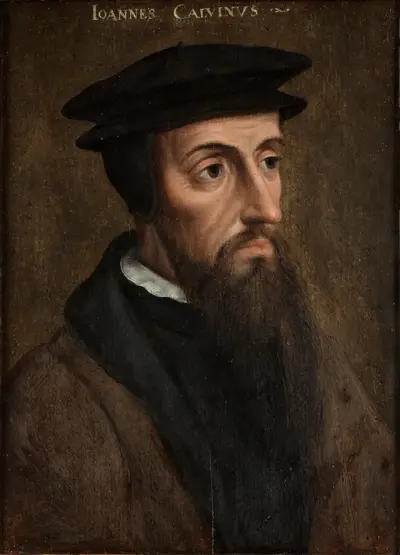
John Calvin was a French theologian, pastor and reformer in Geneva during the Protestant Reformation. He was a principal figure in the development of the system of Christian theology later called Calvinism, aspects of which include the doctrines of predestination and of the absolute sovereignty of God in salvation of the human soul from death and eternal damnation, in which doctrines Calvin was influenced by and elaborated upon the Augustinian and other Christian traditions. Various Congregational, Reformed and Presbyterian churches, which look to Calvin as the chief expositor of their beliefs, have spread throughout the world.
