Henry A. Kissinger Quotes
The defining issue is that the government in Taiwan was considered to be the government of all of China, and the authorities in Beijing were not recognized as a government of China. So Taiwan was the residuary for all of China.
Kissinger, Henry. On China. Penguin Press, 2011.


This quotation illustrates a huge reversal of policy. When Chiang Kai-shek and the Nationalists were defeated by the Communist Chinese in the Civil War, the Nationalists retreated to the island of Formosa (Taiwan) which was the only Chinese Province they held. There was the thought of setting up a separate nation on Taiwan, but Chiang Kai-shek and the Nationalists insisted that there was only one China and that they were the rightful government. At the time they held the Chinese UN Seat. The Communists also insisted that there was one China and Taiwan was a part of it with the Nationalists there being rebels. Chiang Kai-shek maintained that the people really wanted the Nationalists and they could take back the mainland. That turned out to be unrealistic and then the UN seat was given to the Communists as they were the de facto government of all of China except the province of Taiwan. There was nothing that the Nationalists and Communists agreed upon except that there was one China and Taiwan was a part of it. That, and the request of the Nationalist Chinese, has been the U. S Policy for decades. However by the 21st century, it was clear, even to the most fervent Nationalists, the Chinese Communists had won the allegiance of the majority of the Chinese people and they were not going to be successful in mounting a counter-revolution. Moreover, the Communist Military was much superior and some of the Nationalists started worry that Taiwan would be governed by the Communists along with the rest of China, So Lu and other Nationalists, flip flopped and took the position that Taiwan was an independent country—a view that is not recognized by the U. S. or China.


This was the first of what has come to be known as "the three communiqués" that were issued to open the way for Richard M. Nixon and Kissinger's opening of relations with Communist China. It articulates what has come to be known as the "one China policy," and has subsequently been reiterated by other American administrations.


The Kuomintang nationalists under Chiang Kai-Shek tried to stay in power in China, but their corruption and incompetency at government lost them the support of most of the Chinese. The Chinese communists took over the government. The Nationalists then invaded the offshore island of Taiwan but claimed to be the rightful government of all of China. For many years they controlled the Chinese seat in the UN and they refused to recognize the fact that they had failed to gain the loyalty of the Chinese people.
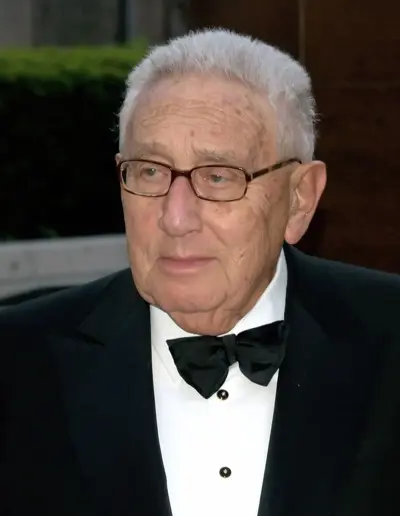
Henry Alfred Kissinger KCMG is an American politician, diplomat, and geopolitical consultant who served as United States Secretary of State and National Security Advisor under the presidential administrations of Richard Nixon and Gerald Ford. A Jewish refugee who fled Nazi Germany with his family in 1938, he became National Security Advisor in 1969 and U.S. Secretary of State in 1973. For his actions negotiating a ceasefire in Vietnam, Kissinger received the 1973 Nobel Peace Prize under controversial circumstances, with two members of the committee resigning in protest.
