James Monroe Quotes
The crime of ingratitude has not yet stained, and I trust never will stain, our national character. You are considered by them as not only having rendered important service in our own revolution, but as being, on a more extended scale, the friend of human rights, and able advocate of public liberty. To the welfare of Thomas Paine, the Americas are not, nor can they be, indifferent.
Monroe, James. "To Thomas Paine." 18 Sep. 1794. The Writings of James Monroe, edited by Stanislaus Murray Hamilton, vol. 2, G.P. Putnam's Sons, 1899, p. 86.


Montgomery was killed later that year commanding the failed attempt to capture Montreal in Canada


Hopkins was complaining about the fact that England could tax the colonies and thereby take their property without their consent made the American colonists in the “miserable condition of slaves.” Essentially the fundamental complaint of the Americans was this and in a decade it would erupt as the American Revolution. At the same time, Hopkins was a slave owner and yet saw nothing wrong with that.


The Illuminati was a secret society. At the time, anyone who differed with the Church on issues of philosophy, ethics or religion could be tortured and burned at the stake, and anyone who criticized the Monarchy could be tortured and hung or beheaded. The result was the concept of a secret society of which the Illuminati was one.
Cochrane became the Admiral in Chief of 2 Different South American Nations—Peru and Brazil—fighting for their independence. Incredibly enough, he was able to form idealistic freedom fighters with no naval experience into navies which defeated both the Spanish and Portuguese fleets at a time when those countries had world class navies. His achievements on behalf of the South Americans are often regarded as the most remarkable naval achievements in history.
Mackenzie was a British officer with whom Washington had become friends in the French & Indian War and in this letter, Washington was trying to explain the seriousness of the Boston rebellion for Britain.


In the election of 1800, the Jeffersonian republicans were pitted against the John Adams Federalists. The latter had seen the revolution as against the excesses of England and King George and not necessarily against the notion of a class society where government served the interests of the upper class—a political battle that is still with us to some extent. The Jewish religion generally recognizes no right of theocratic authority of one man over others with all to follow the laws of God, was theologically very republican. Rabbis were teachers and had no theological or civil authority. To Nones and many other Jews the Jeffersonian ideals were very close to their religious and cultural tradition and to the extent that there has been a party of the classes and a party of the masses, most Jews had gravitated to the latter with the exception of merchants, bankers and others whose economic interests were with the right of center party.

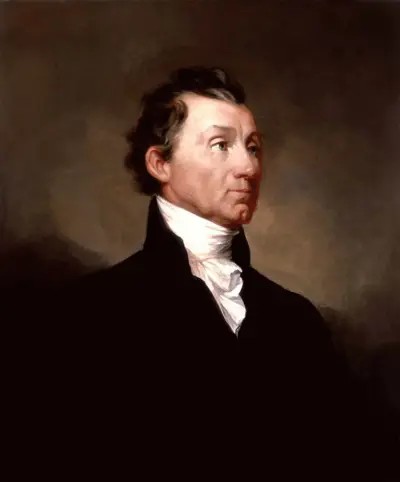
James Monroe was an American statesman, lawyer, diplomat and Founding Father who served as the fifth president of the United States from 1817 to 1825. A member of the Democratic-Republican Party, Monroe was the last president of the Virginia dynasty; his presidency coincided with the Era of Good Feelings. He is perhaps best known for issuing the Monroe Doctrine, a policy of opposing European colonialism in the Americas. He also served as the governor of Virginia, a member of the United States Senate, the U.S. ambassador to France and Britain, the seventh Secretary of State, and the eighth Secretary of War.
