William O. Douglas Quotes
The court is really the keeper of the conscience, and the conscience is the Constitution.
Douglas, William O. The Court Years, 1939-1975: The Autobiography of William O. Douglas. Random House, 1980.


Referring to the Brown v. Board of Education, the Topeka, KS, Supreme Court school desegregation decision:

Judicial Review is the principle which allows a court—judges—to declare an act of the legislature or the executive improper and unlawful. It is a standard principle of American government yet it was not explicitly stated in the Constitution. Hence to some, there is a question about the legitimacy of Judicial Review itself. Many nations do not have it. Many people think it is the most important aspect of a democratic society as it provides a check on both the executive and the legislature.

Hatch was the chairman of the Senate Judiciary Committee at the time.


It is argued whether Scalia’s problem was that the Supreme Court was doing something new or radical or the country had changed. He had certainly lived through the greatest transformation of any society and culture on earth at a pace of change that far exceeds anything that has occurred before. Scalia is one who believes that the Constitution should not be interpreted in recognition of these changes, but should be immutable as it was written for the late 18th century. Most judges and legal scholars disagree and try to interpret the Constitution as the founders would have intended, knowing what we know, having the tools and powers we have, and facing the problems of the modern world. It represents a major legal and philosophical debate.

This concept of balance of power and the equal role of the judiciary is actually quite rare. Even in Parliamentary democracies the parliament can override any court interpretation. In England, the upper legislative house, the House of Lords, actually serves as the nation’s highest or supreme court. And these “Law Lords” can override all regular judicial bodies.


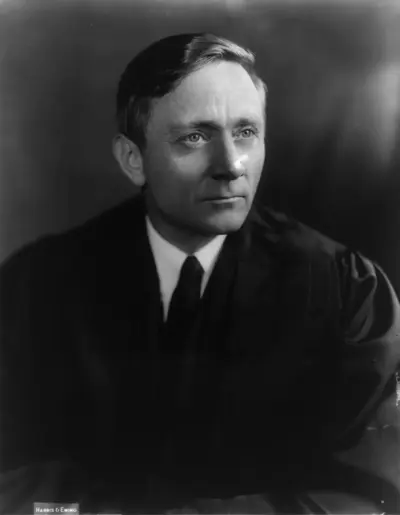
William Orville Douglas was an American jurist and politician who served as an associate justice of the Supreme Court of the United States. Nominated by President Franklin D. Roosevelt, Douglas was confirmed at the age of 40, one of the youngest justices appointed to the court. His term, lasting 36 years and 211 days (1939–75), is the longest in the history of the Supreme Court. In 1975, Time magazine called Douglas "the most doctrinaire and committed civil libertarian ever to sit on the court."
