Antonio Canovas del Castillo Quotes
The constitution should be formed on principles as liberal as the condition of the country will allow.
Antonio Canovas del Castillo, 1828-1897, Politician and historian, Quoted in Williams, The Story of Spain
Sourced by: Eigen's Political and Historical Quotations


The committee to draft the Dutch Constitution had met and agreed on a basis for the constitution they would write. However, they decided to run the basis past the General Assembly before they started drafting specific language. There was much enthusiasm for their basis although there were a number of more conservative delegates who would rather have seen the Orangist monarchy brought back. It is easy to see how the United States Constitution and Bill of Rights influenced the Dutch drafters even though the American Constitution was only 11 years old.


In 1974 the Senate Foreign Relations Committee was investigating the wiretapping of American citizens. An FBI witness, Bernard Wells, testified that the wiretaps had demonstrated no disloyalty but they had identified some "loose talk:"


Over 1000 people had registered to be candidates in the Iranian national election. However, under the Iranian Islamic Constitution all candidates have to be approved by the Guardian Council of Ayatollahs who are appointed by the Supreme Leader, also appointed. The Guardian Council found that all candidates but 6 were not worthy enough Muslims to be allowed to run for public office. 2 of the over 1000 rejected candidates were very prominent Iranians. The Supreme Leader made this statement which seems very reasonable and democratic until his order to the Guardian Council is considered. He ordered them to reconsider 2 or the 1000 rejected candidates.


Citizen of U. S. & Israel


Essentially, Scalia held that it was the job of the legislature to correct evils of society that he felt were not specifically mentioned in the Constitution. Other justices have argued that if the things are so evil and serious that they deny an individual the rights that were mentioned in the Constitutional, then they might be unconstitutional.

This was an insult to the George W. Bush administration which had stretched the Constitution more so than any previous administration, had asserted Presidential powers that had never been asserted before and had had several of its more controversial policies and practices overturned by the Supreme Court.
Despite Ziglar’s and other officials pointing out the illegality, illegal sweeps and arrests were made without warrants or constitutional requirements.

Powell was the Secretary of State and Addington kept advising the administration that as long as the President was acting in defense of the country in his capacity as Commander in Chief, he did not have to obey any existing laws that had been Constitutionally passed which in the opinion of the President restricted or limited the President or the executive branch. Addington was an attorney and Assistant to the Vice President, but he was given much responsibility for administration policy. Powell the Secretary of State of the Administration could not have disagreed more and although most politicians including Republicans disagreed with the Addington thesis, Powell was one of the few Republicans to criticize the Addington position.

John Adams wrote the draft.
There are many countries that adhere to a rule of law, for which their Constitution is the fundamental document providing a framework for their legal system which is adhered to. A few nations which are strong adherents to the rule of law, but have no constitution; the instead have a very strong system of Common Law which establishes their legal precedents and a legislative tradition of restraint which provides fixed principles (Great Britain and Israel are two good examples). But the biggest problem for many countries in not adhering to the rule of law, is having a written constitution and then ignoring it when making legal decisions for the nation, Balaguer’s quotation here is typical of the attitude which causes nations with fine constitutions to function without any serious adherence to rule of law.

From this quotation, {615902} and {615901} it is clear that the framers of the Constitution intended the treaty making powers to be shared by the President and the Senate. In practice, in modern times treaties are usually initially negotiated by diplomats under the supervision of the President and the Senate gets to concur or not in the ratification process. However, there have been a number of treaty failures including the League of Nations where the lack of coordination has resulted in a situation where the Senate had to accept or reject something which the President had negotiated and the Senate rejected the treaty.
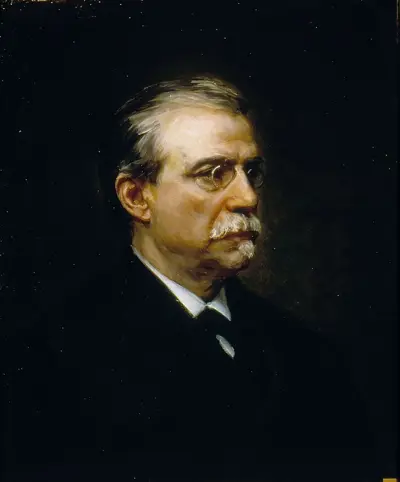
Antonio Cánovas del Castillo was a Spanish politician and historian known principally for serving six terms as Prime Minister and his overarching role as "architect" of the regime that ensued with the 1874 restoration of the Bourbon monarchy. He died in office at the hands of an anarchist, Michele Angiolillo.
