Robert Mugabe Quotes
The Commonwealth is a mere club, but it has become like Animal Farm, where some members are more equal than others. How can Blair claim to regulate and direct events and still say all of us are equals?
Mugabe, Robert. Speech to the ZANU-PF Annual Conference. Masvingo, 7 Dec. 2003.


In the Nez Perce and most other Native American societies, there were Chiefs and occasionally, for special circumstances, War Chiefs, but few if any other officials, thus producing a very flat, egalitarian society. But the whites had many layers of bureaucrats and petty officials. Governors, The President, Members of Congress, State Legislators, Generals, Sheriffs, Indian Agents, tax collectors, and the like. On the Papago Indian reservation, there was great difficulty on a construction project as even the concept of a work foreman was an uncomfortable notion. No Papago wanted to be directed or ordered about by anyone else even on a work gang. And do no one wanted to assume a position of authority or be responsive to a fellow other than the Chief and the tribal elders.

This famous line actually had a predecessor. See {624357} for an over 60 year eariier expression of the notion. It is not known for certain if Orwell was aware of the earlier use.


AEI, though a conservative think-tank, with this approach departed far from the then current Republican Party that was highly influenced or even controlled by the Tea Party faction.


This is one of the best short quotations about the conflict between freedom and equality or fairness. Economically, if large companies and monopolies are totally free and unregulated, they often prey upon the small companies and consumers and the community in general. Regulation restricts the freedom of the regulated entities and inhibits investment and growth.


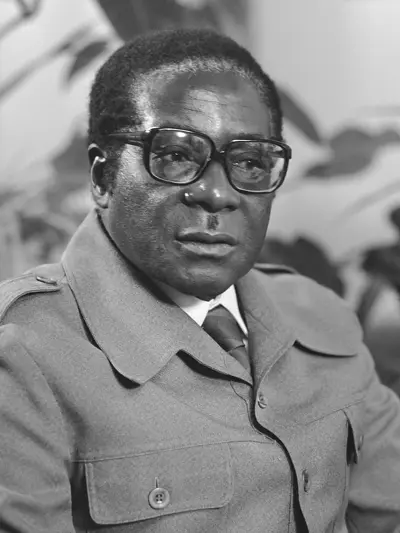
Robert Gabriel Mugabe was a Zimbabwean revolutionary and politician who served as Prime Minister of Zimbabwe from 1980 to 1987 and then as President from 1987 to 2017. He served as Leader of the Zimbabwe African National Union (ZANU) from 1975 to 1980 and led its successor political party, the ZANU – Patriotic Front (ZANU–PF), from 1980 to 2017. Ideologically an African nationalist, during the 1970s and 1980s he identified as a Marxist–Leninist, and as a socialist after the 1990s.
