New York Times Quotes
The churches of the Presbyterians, Baptists, and Methodists were not open. They do not accept Christmas as a holy day, but the Episcopal, Catholic and German churches were all open and decked with evergreens.
This historical quote is important because it shows that there was great dissention about the celebrating of Christmas even among different Christian sects. Traditionally, the celebration of Christmas in a government building or school would have offended half the Christian population. In early America, Christmas celebration was legally prohibited in some states and required in others. This was one of the reasons that the Founding Fathers wrote the First Amendment into the Constitution. In modern times, some critics accuse the requirements that Christmas celebration in public facilities as being anti-Christian. But the problem has been with America since before the Constitution.
New York Times, December 26. 1855
Sourced by: Eigen's Political and Historical Quotations

This is a quotation which shows that Christmas was not a Christian Holiday that was commonly celebrated in early America. The reason that this is important is when there were many legal battles of public schools and municipalities celebrating Christmas and exhibiting crèches and Christmas trees, several of the proponents argued the doctrine of originalism—namely that we should not declare unconstitutional anything that was common and accepted at the time of the Constitution’s writing, debating, and ratification. They argued that the First Amendment was not intended to cover celebrations of Christmas as the founding fathers would not have made unconstitutional that which was common. While the principle of originalism has advocates and critics, the originalism theory does not hold regarding Christmas because Christmas was not commonly celebrated in early America. In no state was Christmas a holiday, and there were jurisdictions that had actually outlawed the celebration of Christmas which was associated with Catholics and not all of them. See {629845} for another.

This is the first state to make Christmas a legal holiday. The reason that this is important is when there were many legal battles of public schools and municipalities celebrating Christmas and exhibiting crèches and Christmas trees, several of the proponents argued the doctrine of originalism—namely that we should not declare unconstitutional anything that was common and accepted at the time of the Constitution’s writing, debating, and ratification. They argued that the First Amendment was not intended to cover celebrations of Christmas as the founding fathers would not have made unconstitutional that which was common. While the principle of originalism has advocates and critics, the originalism theory does not hold regarding Christmas because Christmas was not commonly celebrated in early America. See {629845} and {629843} for more evidence on this point.

Kennedy was being hurt be fears that as a Catholic, he would be beholden to the Pope and the Catholic Bishops. There were many protestants who believed that the Catholic Church was antithetical to democracy and some who even believed that Catholicism was the religion of Satan. Kennedy decided to confront the issue head on.


In the city of Narragansett, RI, there Lester York had each Christmas season dressed up as St Nicholas, 4TH century Catholic Bishop, the precursor to Santa Clause. He played the part of the Bishop and discussed Christmas in that context. The presentation was very educational as students could learn of the culture of that time but they also received an authentic religious sermon of the time. By inviting York into the public elementary schools, the students were learning some history and culture but they were also involved in a religious service and doctrine—the divinity of Christ. The former was good; the latter illegal as the public schools were in addition to educating historically communicating religious messages. York’s presentations had many supporters who had argued that York’s presentation conveyed Christian messages very well and children should not be denied that opportunity. After much community discussion, the public schools withdrew their invitation to York, and he gave his excellent presentation in many community churches.
Christmas, it is sometimes legally argued, was ubiquitous in America and not just a Christian holiday. But as this quotation demonstrates, Christmas was not even celebrated by many of the Christian Churches as late as 1886. See {629844} for a similar example. A number of Protestant religions forbid the celebration of Christmas until relatively recently.

This is a quotation which shows that Christmas was not a Christian Holiday that was commonly celebrated In early America. The reason that this is important is when there were many legal battles of public schools and municipalities celebrating Christmas and exhibiting crèches and Christmas trees, several of the proponents argued the doctrine of originalism—namely that we should not declare unconstitutional anything that was common and accepted at the time of the Constitution’s writing, debating, and ratification. They argued that the First Amendment was not intended to cover celebrations of Christmas as the founding fathers would not have made unconstitutional that which was common. While the principle of originalism has advocates and critics, the originalism theory does not hold regarding Christmas because Christmas was not commonly celebrated in early America. In no state was Christmas a holiday, and there were jurisdictions that had actually outlawed the celebration of Christmas which was associated with Catholics and not all of them. See {629843} for another.
Christmas was not celebrated in England universally until relatively modern times as in the United States. However for much of the history of England it was outlawed to celebrate Christmas. Generally, Catholics celebrated Christmas and Protestants opposed it. See {629839}, {629840}, {629847}, {629848}, {76420}.

Throughout the United Kingdom, there have been major traditional forces prohibiting the celebration of Christmas as a holy day or holiday. This carried over to America where Christmas was never a commonly celebrated day until modern times. The reason that this is important is when there were many legal battles of public schools and municipalities celebrating Christmas and exhibiting crèches and Christmas trees, several of the proponents argued the doctrine of originalism—namely that we should not declare unconstitutional anything that was common and accepted at the time of the Constitution’s writing, debating, and ratification. They argued that the First Amendment was not intended to cover celebrations of Christmas as the founding fathers would not have made unconstitutional that which was common. While the principle of originalism has advocates and critics, the originalism theory does not hold regarding Christmas because Christmas was not commonly celebrated in early America. In no state was Christmas a holiday, and there were jurisdictions that had actually outlawed the celebration of Christmas which was associated with Catholics and not all of them. See {629845}, {629843}, {629842}, {629844}, and {629845}.
In the case of Christmas celebrations, in addition to the huge commercial consequences, there is tradition and religion involved which brings out non-monetary vested interests as well. This is true in England as well as America.
At the time there was an issue of religious freedom that is in public discourse: It emanated from the Obama Care law which required employers to provide health insurance that does not discriminate against women by refusing to disallow coverage for birth control (pills, diaphragms, etc.) This legislation covered the employees of general institutions run by religions such as schools, hospitals, and retirement communities. Roman Catholics and other religions which viewed birth control as a sin were put in a position where they had to pay for something that they regarded as sinful. So the church did not have complete religious freedom. However, if these institutions would deny to their employees a basic right that the law says belongs to all institutions. If an exception would be made for birth control what about blood transfusions. The Jehovah’s Witnesses believe that autologous blood transfusions are contrary to the world of God. So what if institutions they run decided to not cover these transfusions in their insurance policies? Or a Jewish University or a Muslim cultural center decided not to cover medical procedures in hospitals that serve pork? There have been many examples where one religion’s freedom has been curtailed slightly when they conflict with individual rights or other rights. Plural marriage for Mormons and Muslims are against the law. Christian Scientists have been forced to provide medical care for some members even though their religion prohibits it. There is no solution that will not curtail someone’s rights under some circumstances.

His intolerance and bigotry not only is of Muslims and Hindus, but extends to some Protestant denominations as well. See {643060} for additional examples of bias on the part of this erstwhile Presidential aspirant. To him, religions, unless they agree with his religious beliefs, are evil and dangerous to society.
This statement differs from the view espoused by many Muslims in regards to Christians. See {590207}.
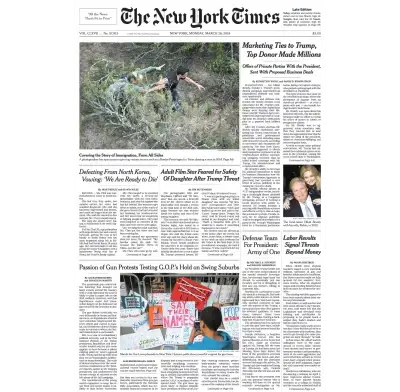
The New York Times (NYT or NY Times) is an American daily newspaper based in New York City with a worldwide readership. Founded in 1851, the Times has since won 130 Pulitzer Prizes (the most of any newspaper), and has long been regarded within the industry as a national "newspaper of record". It is ranked 18th in the world by circulation and 3rd in the U.S.
