Max Weber Quotes
The capacity for the accomplishment of religious virtuosos the "intellectual sacrifice" is the decisive characteristic of the positively religious man. That this is so is shown by the fact that in spite of (or rather in consequence) of theology (which unveils it) the tension between the value-spheres of "science" and the sphere of "the holy" is unbridgeable.
Weber, Max. "Science as a Vocation." From Max Weber: Essays in Sociology, translated and edited by H. H. Gerth and C. Wright Mills, Oxford University Press, 1946, p. 154.


This quotation is familiar, but there is a question concerning its veracity and source. It does not appear in Heisenberg's written works, but it is cited by Ulrick Hildebrand in 'Das Univerzum - Hinweis auf Gott?' in 'Ethos. Die Zeitschrift fur die Ganze Familie', Berneck, Schweiz: Schwengeler Verlag AG, No 10, Oktober 1988, 10


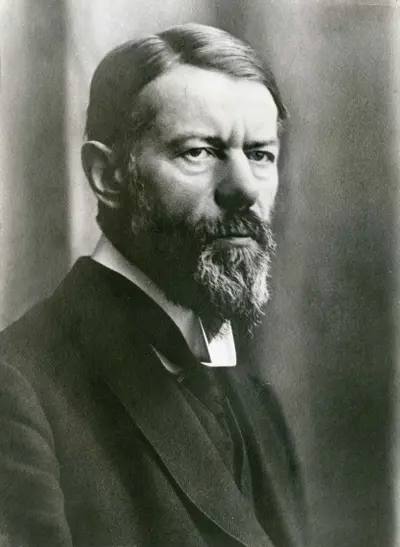
Maximilian Karl Emil Weber was a German sociologist, historian, jurist, and political economist, who is regarded among the most important theorists on the development of modern Western society. His ideas would profoundly influence social theory and social research. Despite being recognized as one of the fathers of sociology, along with Auguste Comte and Émile Durkheim, Weber never saw himself as a sociologist, but as an historian.
