Anthony Benezet Quotes
The best endeavors in our power to draw the notice of the governments, upon the grievous iniquity and great danger attendant on a further prosecution of the slave trade, is what every truly sympathizing mind cannot but earnestly desire, and under divine direction promote to the utmost of their power
Benezet was a Huguenot whose family had been persecuted in France. He identified with the cause of Blacks, Indians and Acadians. He was also one of the first leaders of the American Peace Movement.
Anthony Benezet, 1763-1784, Educator & Early American Abolitionist, Plea to General Amherst who had come to New York to attack the Indians, 1763
Sourced by: Eigen's Political and Historical Quotations

As an entertainer she had toured much of the world and seen American slavery and that of some other nations. She became a staunch abolitionist and like entertainers in the 20th and 21st centuries she used her celebrity to give anti-slavery lectures and perform for audiences where she donated the proceeds of the event to the abolition cause. She is a particularly interesting political figure in that she seems to be one of the first entertainers to perform for a social cause and become an activist.


The issue of slavery which had been suppressed in Congress for the first decades of the nation broke out when Missouri statehood was considered. By previous agreement, slavery was not even discussed in Congress but the time period elapsed. Tallmadge not only proposed that no more slaves could come into Missouri {613176} but most shocking to the Southerners was that every person born in the new state would be free at the age of 25. In a generation, there would be no more slavery in Missouri and there would be no economic compensation for slave owners at all. The House of Representatives accepted the amendment, but it failed in the Senate. At that time, Senators were not elected by voters but were appointed by the state legislators and the Southern slave states had a disproportionate share of the senate from a population point of view. But what this quotation shows clearly that a majority of the country in 1819 were opposed to slavery and were willing to end it without compensation.

The first anti-slavery newspaper published in the United States & the first journal in America to advocate immediate, unconditional emancipation


“Manumitting” means the freeing of slaves. See Quotation 643600 for Laurens’ view of slavery despite the fact that he was a substantial slave owner. He was willing to lose the money represented by the value of his slaves, but most slave owners self interest was to the contrary. One of the most interesting thing about this quotation is the fact that Laurens received so much opposition from his fellow South Carolinians and other Southerners despite the fact that only Laurens would lost money by freeing his slaves. Even slave owners who wanted to do the right thing and were willing to lost the money were under enormous social and political pressure not to free slaves.


This moral statement from a New jersey Quaker abolitionist is not particularly noteworthy, However what makes this quote important is that Woolman traveled throughout the South preaching this as his main theme. At that time — before the American Revolution — he did so and was not attacked or intimidated; he was mostly ignored by the Southern authorities. At the time, the South was very confident of its ability to continue slavery. Years later, when the abolition movement grew larger and stronger, a Northern Quaker Preacher doing this not not escape with his life.
Later changed the name to The Emancipator. Many are surprised that a Southern State would have had such strong abolitionist sentiment so early, but East Tennessee was a hotbed of abolition. See {614117} and {614069}


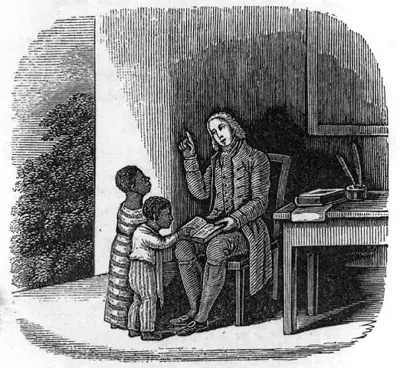
Anthony Benezet, born Antoine Bénézet, was a French-American abolitionist and educator who was active in Philadelphia, Pennsylvania. One of the early American abolitionists, Benezet founded one of the world's first anti-slavery societies, the Society for the Relief of Free Negroes Unlawfully Held in Bondage (after his death it was revived as the Pennsylvania Society for Promoting the Abolition of Slavery); the first public school for girls in North America; and the Negro School at Philadelphia, which operated into the nineteenth century. He was a vegetarian and advocated for the kind treatment of animals, integrating this in his teachings.
