Erich Raeder Quotes
... the basic principles of the military services are unchangeable. Courage and candor, obedience and comradeship, love of fatherland and loyalty to the State: these are ever the distinguishing characteristics of the soldier and sailor. Building character through intelligent training and education is always the first and greatest goal.
Raeder, Erich. My Life. United States Naval Institute, 1960.


Westmoreland’s critics point to this quotation as an illustration of exactly why he was the wrong man for the job. As Vietnam Supreme Commander, he controlled more firepower than any other military leader in history and yet he had “no room” for thought or reason much less mercy. Subsequent commanders of U. S. military efforts were much more sophisticated like, Colin Powell, Norman Schwarzkopf, and Wesley Clark who were leading American thinkers, sophisticated at political and military reasoning and very capable of mercy. The modern American military requires men and women who are skilled at thinking and reasoning.


“Volk” loosely translated means “the people.” However it carries the connotation of a unity that “the people” does not.

Colonel Banks had given him the Regimental colors flag and urged him to take care to return it with honor. This was his famous reply. In the midst of the Battle he was hit fatally with a cannonball. A Black corporal then took up the colors and he too was killed and yet another Negro corporal took the flag and returned it after a battle where the Blacks were commended for their valor. This quotation has been quoted to military men and women throughout the world as an outstanding example of military bravery and honor..


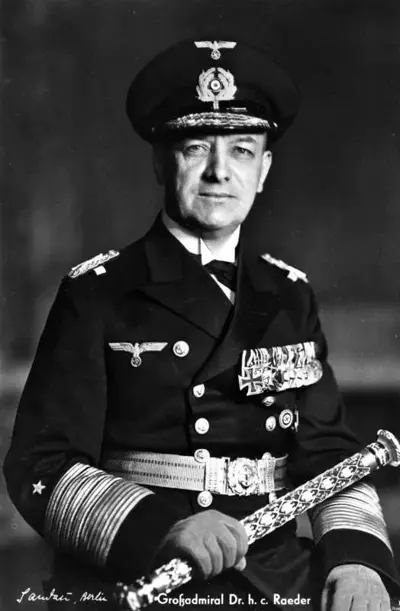
Erich Johann Albert Raeder was a German admiral who played a major role in the naval history of World War II. Raeder attained the highest possible naval rank, that of Grand Admiral, in 1939, becoming the first person to hold that rank since Henning von Holtzendorff. Raeder led the Kriegsmarine for the first half of the war; he resigned in January 1943 and was replaced by Karl Dönitz. At the Nuremberg Trials he was sentenced to life imprisonment but was released early owing to failing health.
