Abdullah Öcalan Quotes
The attempt to suppress new religious, linguistic, cultural, intellectual and political developments during past centuries was the cause of all major wars.
Abdullah Öcalan, Turkish Terrorist & founding leader of the Kurdish militant group Kurdistan Workers Party (PKK), Testimony at his 1999 trial for murder and terrorism
Sourced by: Eigen's Political and Historical Quotations


He is a Greek Orthodox Christian, and he correctly observes that the Islamic world was considerably more tolerant than the Christian until the 18th century when Islam had become less tolerant in the Middle East while the Christians were modernizing and going through a cultural and intellectual enlightenment and societal modernization while the Muslims, became less tolerant than they were in earlier years leading to the modern situation.


Shahin’s empire which he conquered for Khosrow II comprised all of the Middle East into parts of India. The Byzantine Roman Empire controlled everything from Constantinople to the West. They were the two “superpowers” of the day. Shahin was attacking various Byzantine holdings outside of the city of Constantinople. Even before Islam, religion was a major conflict between East and West.

From the latter part of the 20th century onward, religious nationalism was no longer a force for most religions and nations except Muslim countries. It was the only religion left where a large proportion of the adherents saw no distinction between the religion and the government. Nations that had separation of church and state were not conducive to the extreme fundamentalist form of Islam where the Secular Leader and the Religious leader was to be embodied as a single person. As a result Islamic religious nationalists argued for a Theocracy and at times fought for it with violent means. The secular government typically, to curtail the violence and prevent a religious takeover, often outlawed the extreme religious Islamic parties. While Aslan cites the Muslim Brotherhood failure in Egypt as a desirable outcome, the only way the other forces of Egyptian society could prevent the Islamists from taking over turning the country into a theocracy was to forcefully repress the extremists. The Turkish outcome was much better, but there was the threat of repression of the Justice and Development Party when it won a majority control of the government. There were explicit threats that if it tried to weaken the secular nature of the government as Ataturk had formulated it, the military would come “out of the barracks” and oust the government as they had done before. There were nations like China which persecuted religions such as certain forms of Christianity, but those religions were not fighting for religious nationalism. They only wished the freedom to practice their religion and had no program or theology that argued for Christianizing the government. The Tamil Hindus of Sri Lanka did not want a Hindu government and were perfectly free to practice their religion. The problem was that they felt that there was systemic social and economic discrimination against the Tamils and they fought for independence—not of a Hindu state, but of a secular, nondiscriminatory state of equal opportunity.

In the early stages of Islam, Muhammad had hoped to convert the Jews and others on the Arabian Peninsula. When they refused to be converted, he warred against them usually killing the men, and taking the women and children as slaves. The result was that non-believing tribes were “cleansed” from the Arabian Peninsula. The Muslims at the time preferred children as slaves. For then they could convert the children against their will. Adults in Islam must accept Islam in order to convert. Children are regarded as having no such maturity of decision making and therefore opposition to conversion may be ignored and they may be forced. Critics of Islam and those who argue that Islam is at odds with all other religions point to this quotation. They claim that it is the only religion whose founder and fundamental scriptures demand war against others for no other reason than that they believe in a different religion. The Catholic Church during the Crusades and the Inquisition had a similar philosophy as did Christian missionaries colonizing Africa later. One difference is that most Christians today repudiate the doctrine as against the true spirit and teachings of Christ and view it as historical error, while very few modern Muslims repudiate this quotation of the Prophet.

In 1453 the Ottoman Turks shocked Christendom by capturing Constantinople, the capital of the Byzantine Eastern Christian Empire. It was always perceived as a religious conflict between Christians and Muslims but that is an over simplification of a very complex sociological, religious, and political historical period. As this quotation shows us there were many Christians aiding the Muslim side. There were also many Muslims fighting on the Christian side.


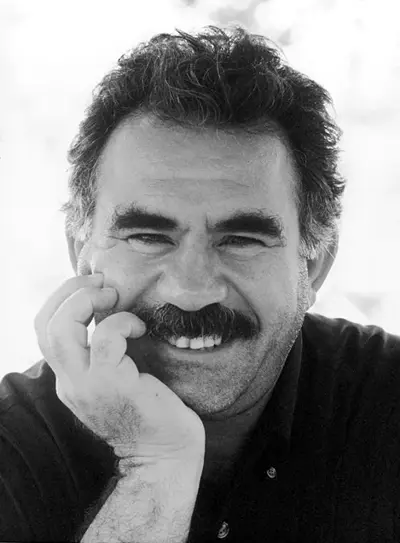
Abdullah Öcalan, also known as Apo (short for both Abdullah and "uncle" in Kurdish), is a Kurdish nationalist, political prisoner and one of the founding members of the militant Kurdistan Workers' Party (PKK).
