Bob Graham Quotes
The American people do not have the information upon which they can hold the administration and responsible agencies accountable. I call that a coverup.
Graham, Bob. Interview by Bob Schieffer. Face the Nation, CBS, 10 Aug. 2003.


See {158152} for his view on secrecy in government.

Agree resigned from the CIA in protest to its political position.


of the September 11 Commission

Every military establishment has secrets that they should maintain and are not always forthcoming with facts d explanations. However, the Pentagon is so large with so many layers that there are subgroups and vested interests, prevaricate and lie, even to their own superiors. No one knows how prevalent this is, but there have be a number of major incidents where the were lies and cover-ups—usually to prevent public embarrassment to some element of the military industrial complex.

The irony of this quotation is that he is the architect and controller of the Russian system that he is criticizing.

Gelb was referring to the Cuban Missile Crisis in 1963. The Russians had installed ICBMs in Cuba and more were coming by sea. WWIII could have started with a misstep by the United States or the Soviet Union. President rejected the advice of some hawks to attack and/or invade Cuba and be ready to attack Russia with nuclear weapons. Instead, he authorized a naval blockade of all ships and planes going in or out of Cuba. There were some negotiations with the Russians, and in a few days, the Russians dismantled and removed the missiles from Cuba and we lifted the naval blockade. The perception was that Kennedy faced down the Russians who capitulated when faced with firmness and force. Actually, Kennedy gave the Russians much more. He agreed to remove the American ICBM Jupiter missiles from Turkey. But if that were known in America, the right wing would criticize Kennedy mercilessly for appeasing and capitulation to the Russians. The Russians agreed to keep it secret, and the Executive Branch classified it top secret and kept the entire deal from the public. 50 years later, Gelb, one of the few people in the government then who knew the entire deal, wrote this article pointing out that there was a serious danger to what we did to make that deal a secret. Many hawks took the Cuban Missile Crisis as proof that the Russians would back down when faced with a fait accompli and would not retaliate. They then formulated much American foreign and military policy on the assumption that the Russians will capitulate when faced with our tough unilateral terms. The reality of course was just the opposite. The Russians would only agree to a peaceful solution if we withdrew all our missiles that were threatening them and end the naval blockade of Cuba. The Russians got us to remove our missiles for the relatively cheap price of removing from Cuba just a few missiles that they had just installed. Kennedy looked like the strong hero who stood up to the Russians while in reality, he and our military and state department lost a diplomatic contest of sorts. Kennedy apologists argue that because America had developed longer range ICBMs, the Jupiter Missiles in Turkey were not that important, and Kennedy really gave up nothing of value. The Kennedy team clearly didn’t want to argue that point in a public debate, and chose secrecy where the enemy clearly knew the whole story, but our allies, our civilians, our politicians and even most of our military were in the dark.

Senator Dianne Feinstein, Chairman of the Senate Intelligence Committee, had released an unclassified Summary of the Committee Report on the CIA using torture and perverse treatment of suspect terrorists in the aftermath of the 9-11 attack on New York. Most Republicans argued vehemently that the Report should be classified and kept secret as the CIA behavior was so egregious, unpalatable, and morally reprehensible that there would be negative consequences including perhaps demonstrations and attacks against Americans in foreign countries. Moreover, Terrorist organizations would use the heinous CIA behavior as a recruiting tool for anti-American terrorists. McCain, who had himself been the victim of North Vietnamese torture cited the moral and ethical reasons to prohibit torture but also explained what has been proven over and over again that torture victims will tell the torturer any nonsense that they think the torturer might believe just to get obtain relief from the agony of the torture.


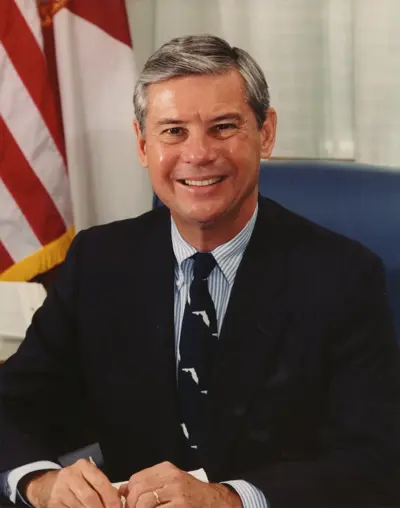
Daniel Robert Graham is an American politician and author who served as the 38th governor of Florida from 1979 to 1987 and a United States senator from Florida from 1987 to 2005. He is a member of the Democratic Party.
