Andrew Jackson Quotes
The agricultural interest of the country is connected with every other, and superior in importance to them all.
Inscribed in the South Lunette of the Library of Congress
Andrew Jackson, 1767-1845, 7th President of the United States (Democrat, TN), Message to Congress, December 8, 1829
Sourced by: Eigen's Political and Historical Quotations

At the time the vast majority of Americans were farmers. That is the tradition and reality which caused the Department of Agriculture to become one of the most important cabinet departments. However, by the 21st century the Department of Agriculture had over 100,000 employees plus many more consultants and contractors. They had done their job so well that productivity eliminated the need for most of the farms. And the number of people earning the majority of their living as farmers is less than 1 million. So there are only 10 farmers for each employee of the Agriculture Department.


Actually, Kerry was incorrect, but he had a point, There are about 110,000 employees of the U. S. Department of Agriculture and every state has their own department of Agriculture with employees. There are about 2 million farms in America. So there is a government agriculture employee for about every 15 farms—a ratio that no other occupation shares.

For many nations, it is an important objective to be totally self-sufficient in their food supply—so that they would not have to depend in other nations in what might be a world famine or food supply. For those nations agricultural subsidies are useful if their farmers cannot produce as cheaply and efficiently as other nations do. In the United States, with the most efficient agriculture in the world, subsidies are a waste of public money {633243} and the result of lobbying and special interest pressure and or corruption {633245}.


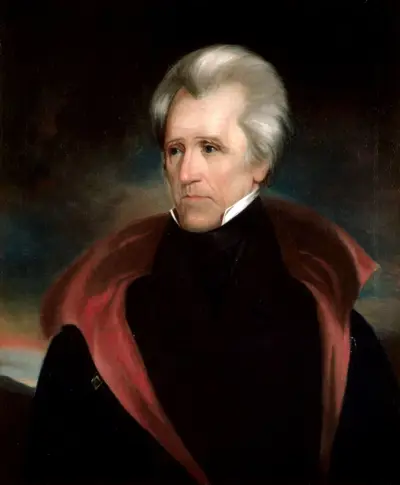
Andrew Jackson was an American lawyer, soldier, and statesman who served as the seventh president of the United States from 1829 to 1837. Before being elected to the presidency, Jackson gained fame as a general in the United States Army and served in both houses of the U.S. Congress. An expansionist president, Jackson sought to advance the rights of the "common man" against a "corrupt aristocracy" and to preserve the Union.
