Tip O'Neill Quotes
That's politics. After six o'clock, we can be friends, but before six, it's politics.
O'Neill, Thomas P., and William Novak. Man of the House: The Life and Political Memoirs of Speaker Tip O'Neill. Random House, 1987.


President Johnson was trying to organize peace talks in Paris. Nixon didn’t want a public announcement to occur before election day when he was running against Hubert Humphrey. Knowing the South Vietnamese President was reluctant to go to Paris but was under pressure from America to do so, he sent a message through Chennault that he should not accept and “hang on” as Nixon would shortly win. The South Vietnam president refused to go to Paris, Nixon won the election, and then had to cope with the continuation of the war that might well have ended before he took office. Nixon believed that he could get Russia and China to pressure Ho Chi Min to make peace. Nixon's private overtures to the South Vietnam president, violated the Logan Act which prohiited private citizens negoatioating with foreign governments. President Johnson was aware of Nixon's commission of this felony want wanted to prosecute him, but the evicence had been obtained from secret intelligene agency bugging and wiretapping both the South Vietnam Embassay in Wishington and the Presidential Palace in Vietnam the public knowledge of which would have caused a scandal. Instead, he called Nixon and warned him to stop, but the damage had already been done, and the South Vitenamese government would not go to Pariis where they would have to agree to a coalition government with the Communists. THey waited for Nixon to deliver a peace treaty which would leave them in charge of South Vietnam. In the final analysis, the South Vietnamese ended up with nothing and no participation in anything when the U. S. Withdrew and the Communists took over.


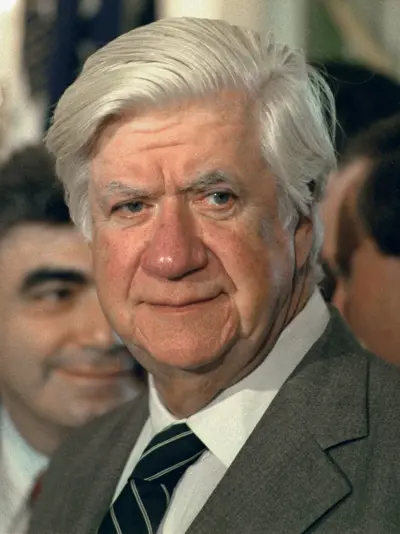
Thomas Phillip "Tip" O'Neill Jr. was an American politician who served as the 47th Speaker of the United States House of Representatives from 1977 to 1987, representing northern Boston, Massachusetts, as a Democrat from 1953 to 1987. The only Speaker to serve for five complete consecutive Congresses, he is the third longest-serving Speaker in American history after Sam Rayburn and Henry Clay in terms of total tenure and longest-serving in terms of continuous tenure (Rayburn and Clay served multiple terms in the Speakership).
