Aristotle Quotes
That which is common to the greatest number has the least care bestowed upon it. Every one thinks chiefly of his own, hardly at all of the common interest; and only when he is himself concerned as an individual. For besides other considerations, everybody is more inclined to neglect the duty which he expects another to fulfill.
Aristotle. Politics. Translated by Benjamin Jowett, Clarendon Press, 1885, p. 29.


Hooker had been a citizen of the Massachusetts Bay Colony when a disagreement broke out that would have profound implications for America. Governor Winthrop wanted to limit the right of voting to members in good standing of the Puritan Church. Hooker, although a Puritan minister himself, dissented and insisted that suffrage be for all regardless of religious affiliation. In June of 1636, Hooker and his entire congregation, driving their cattle and carting their belongings, left Massachusetts and set out for the Connecticut Valley, founding Hartford and a new colony.


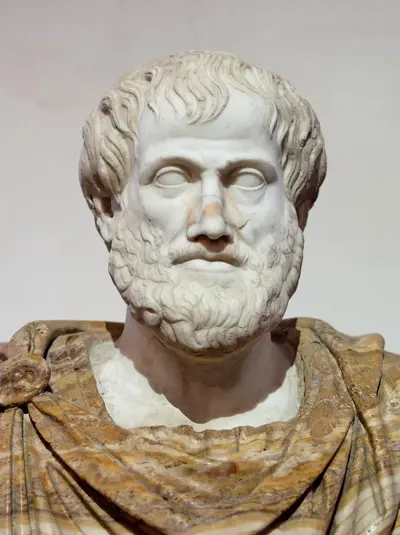
Aristotle (/ærɪˈstɒtəl/; Greek: Ἀριστοτέλης Aristotélēs, pronounced [aristotélɛːs]; 384–322 BC) was a Greek philosopher and polymath during the Classical period in Ancient Greece. Taught by Plato, he was the founder of the Lyceum, the Peripatetic school of philosophy, and the Aristotelian tradition. His writings cover many subjects including physics, biology, zoology, metaphysics, logic, ethics, aesthetics, poetry, theatre, music, rhetoric, psychology, linguistics, economics, politics, meteorology, geology and government. Aristotle provided a complex synthesis of the various philosophies existing prior to him. It was above all from his teachings that the West inherited its intellectual lexicon, as well as problems and methods of inquiry. As a result, his philosophy has exerted a unique influence on almost every form of knowledge in the West and it continues to be a subject of contemporary philosophical discussion.
