Noam Chomsky Quotes
That was the reason why very few people fleeing the rise of fascism in Europe, especially in Germany, could get to the United States. And there were famous incidents like with the MS Saint Louis, which brought a lot of immigrants, mostly Jewish, from Europe. It reached Cuba, with people expecting to be admitted to the United States from there. But the administration of Franklin D. Roosevelt wouldn't allow them in and they had to go back to Europe where many of them died in concentration camps.
Chomsky, Noam. Understanding Power: The Indispensable Chomsky. Edited by Peter R. Mitchell and John Schoeffel, The New Press, 2002.


“Fora” is the plural of forum. It was then preferable to “forums” as the plural form, because “forum” was a Latin word and the Latin plural for nouns ending in “um” was “a” as in “flora and fauna”. This was adopted as U. S. Policy until the second decade of the 21st century when the combination of the War on Terror, and the huge world refugee crises triggered by the Syrian revolution produced much nativist and and-immigration feeling to go along with the small proportion of American anti-immigrants who have almost always been a part of the American pluralistic landscape.

He was a viscious anti-Semite who attracted to his party extreme right wingers, Nazi Sympathers and apologists for the Vichey Franch government. The party was rejected by the majority of French voters, but when his daughter took over the party, she was not an anti Semite but foudn it hard to shake the party's image which was alaysa associated with her name even when she actually kicked her father out of the party.

The inoming President was meeting with and getting briefed by the Director of National Intelligenc, James Clapper and this is the word he used to descrive the American Intelligence Agencies.


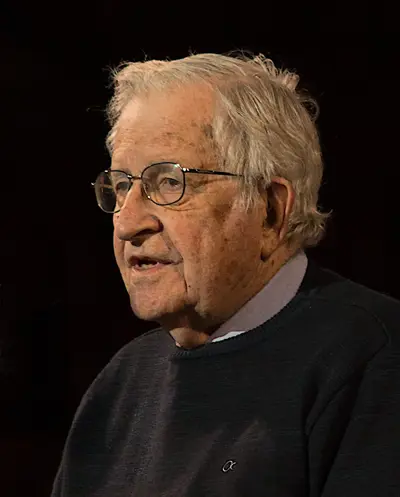
Avram Noam Chomsky is an American linguist, philosopher, cognitive scientist, historian, social critic, and political activist. Sometimes called "the father of modern linguistics", Chomsky is also a major figure in analytic philosophy and one of the founders of the field of cognitive science. He is Laureate Professor of Linguistics at the University of Arizona and Institute Professor Emeritus at the Massachusetts Institute of Technology (MIT), and is the author of more than 150 books on topics such as linguistics, war, politics, and mass media. Ideologically, he aligns with anarcho-syndicalism and libertarian socialism.
