Mo Ibrahim Quotes
Immigrants everywhere have been a wonderful bonus for the host countries. Sometimes it amazes me how anti-immigration feelings arise in Europe or the United States, when immigration has been wonderful for business.
Mo Ibrahim, Sudanese Entrepreneur, Industrialist, and Philanthropist, Interview, Foreign Affairs, January/February 2015
Sourced by: Eigen's Political and Historical Quotations


This is often true despite the fact that the majority of people think that the immigrants are costing more in service provision that they contribute on taxes. In addition the immigrant spend most of their earnings which further benefits the economy. Despite that the British voted to withdraw from the EU so that they could control and reduce the immigration. A similar situation existed at that time in the United States. However, in America the financial tradeoffs are more complex. Each immigrant worker and his employer pay about 15% of his earnings in taxes, but that money goes to the Federal Government. The sales and other taxes that the immigrants pay when they spend their earnings generally go to the state government. Meanwhile, almost all the services, especially education are paid for by the local governments . So typically on each new immigrant the Federal Government has a positive cash benefit, the State government a smaller one, but the local government is cash negative. This anomaly is mostly caused by the fact that the vast majority of the funds that pay for American education come from local property taxes and the immigrants rarely can afford to by property when they first arrive,


He was referring to North African and other third world immigrants. France’s second largest ethnic group had become Muslims from North Africa. But they were only 10 percent of the population.


The party is a neo-Nazi party for who, race was a major issue.

When he became a national candidate, he flip flopped and modified this position to accommodate the strong anti-immigration preference of most of the Republican right wing base.


Although generally a supporter of immigration, he began to oppose it when the very large numbers of immigrants who were ethnically and culturally different began to enter the United States. Northern Italians were OK but the Southern Italians were from a different social class. German Jews had made great contributions to America but the Russian Jews were peasants and serfs. Polish immigrants also. Walker was worried that for the first time in America there would be a social class division as the historical difference between rich and poor in America he believed was within ethnic groups and not between them.


This relatively rarely quoted statement was made by Roosevelt shortly after he graduated from Harvard and was typical of the upper class racism of the day. This is the same man who would be the first to invite a Negro to dine at the White House despite media and public opinion which castigated his act; the same man who later would have several close Japanese friends and be considered very pro-Oriental. This illustrates how people can grow and develop over time—especially politicians. Many politicians with few prejudices have publicly adopted the in order to pander to populist biases of the time. Roosevelt was the opposite. He started out with the popular racism of the day and as he grew and developed, publicly led with exemplary statements and actions. See {588991} for another of his early racist statements—this one targeting Native Americans.

The racial targets of the Japanese and Korean Exclusion League widened and they changed their name to the Asiatic Immigration Exclusion League.
Most immigration reformers want to open immigration more widely. Ward wanted immigration restricted to certain ethnicities and limited. He wanted a uniformity of assimilation and not diversity.

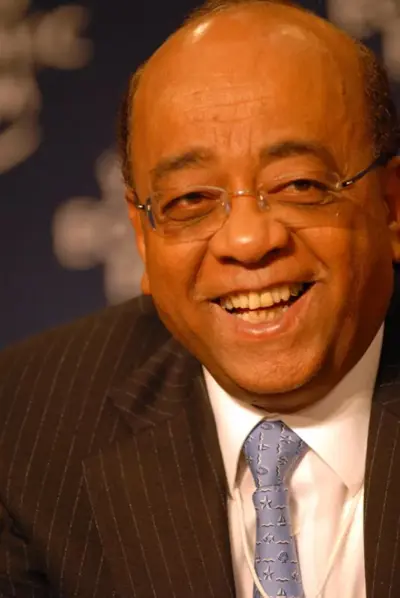
Mohammed "Mo" Ibrahim is a Sudanese-British billionaire businessman. He worked for several telecommunications companies, before founding Celtel, which when sold had over 24 million mobile phone subscribers in 14 African countries. After selling Celtel in 2005 for $3.4 billion, he set up the Mo Ibrahim Foundation to encourage better governance in Africa, as well as creating the Ibrahim Index of African Governance, to evaluate nations' performance. He is also a member of the Africa regional advisory board of London Business School.
