Nathaniel Ward Quotes
That State that will give Liberty of Conscience in matters of Religion, must give Liberty of Conscience and Conversation in their Moral Laws, or else the Fiddle will be out of tune, and some of the strings crack.
Nathaniel Ward, ~1578-1652, Puritan Leader & Codifier, Against Toleration, 1647
Sourced by: Eigen's Political and Historical Quotations


Williams was the first theologian who not only advocated religious toleration but argued that Christianity demanded it and the separation of church and state.


Note the absolutism of the word unbounded.


Abdul Rahman, Afghan citizen, had converted from Islam to Christianity 16 years before. Conversion from Islam is a capital crime under Sharia Law which was the law of Afghanistan even after the Taliban had been overthrown. He was jailed and threatened with death. Statements like this and others made directly to the government persuaded the Afghan politicians to go against their mullahs who demanded the death penalty as is proscribed by Islamic Law—Sharia. The judges tried to get Rahman to recant and he would not (see {589518}). So they finally decided that he must be mentally insane and therefore could not be tried, and the problem was solved that way.

The choice of non-capitalization of the word “god” was Jefferson’s and is retained herein. This quotation is one of the most important in American history because it set the boundary for when it was proper for government to legislate personal behavior. For Jefferson, legislation was only justified if the behavior damged other people economically or physicly. Moral, religious, ethical or cultural affects were not sufficient to interfere with other people's freedom. The quotation was initially given to argue against a state etablished church and blasphemy laws and has been used in arguments even into the 21st century debate over gay marriage.


John Witherspoon, a Presbyterian minister with evangelical sympathies, was one of the signers of the Declaration of Independence.


Quintus Septimius Florens Tertullianus

This is a particularly interesting historical quotation because it succinctly gives a history of the various horrors of religious strife in British history—a history that was very well known to the American Founding Fathers and the general American Colonial population. This history was the major driver behind the public insistence for the Bill of Rights and the 1st Amendment which erected a wall of separation between church and state with government never favoring or abetting any particular religion.


Despite this clear statement, later the Colonial legislature withdrew the franchise from Roman Catholics. See {624149}. Despite this temporary restriction of religious freedom, Rhode Island and Connecticut were far ahead of the other New England colonies in freedom of conscience.
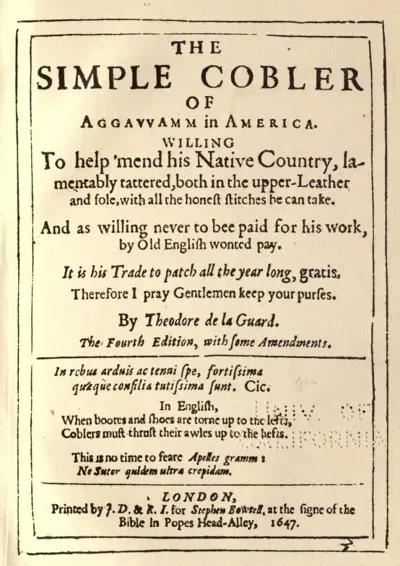
Nathaniel Ward was a Puritan clergyman and pamphleteer in England and Massachusetts. He wrote the first constitution in North America in 1641.
