Gertrude Stein Quotes
That is what war is and dancing it is forward and back, when one is out walking one wants not to go back the way they came but in dancing and in war it is forward and back.
Stein, Gertrude. Wars I Have Seen. Random House, 1945.


Nearly two years after Tripoli had declared war against the United States, the U.S., after much deliberation, decided to stop negotiating a tribute settlement with Tripoli. The U.S. launched their attack on June 11, 1803 in what would be the first amphibious operation on the Barbary Coast. After witnessing the operation, the Pasha was unmoved. Piracy and war was a way of life for the Barbary states.


See {637982} for one of the major reasons.


Kerry, a decorated, former Navy officer, was then a spokesperson for Vietnam Veterans Against the War.

The South could not replenish their lost arms and munitions nor could they replace most of the men wounded, killed or taken prisoner. The Union could do both. Therefore as long as the Union army inflicted casualties, it mattered little who won which battle as long as the fighting was in the South. This critical strategic reality was never appreciated by the Union Generals who were generally reluctant to take large casualties. When Grant and Sherman finally were able to set the strategy of attrition in operation, the Union actually won most of the battles though he and Grant took very high casualties. The casualties of the Confederates were generally higher but they did not have to be for the Union to win. The Civil War was a strategic form of suicide. Ironically, at a few points the rebellion might have succeeded because of the incompetent and timid Union military leadership at the beginning of the war.


In this case, he was referring to the situation with the Barbary Pirates who had an incredible extortion racket going in the Mediterranean. If nations would pay them an annual sum each year, they would not attack and seize merchant ships of that country and sell the ships and goods while holding the sailors for ransom. Jefferson favored and authorized war—a naval attack which for many reasons the European nations had not done (they just paid the tribute). Then a peace treaty was finally signed—the first American Treaty.


Washington was describing the British strategy at the start of the war. The expectation was not only that of the British high command in America but was the prevailing expectation in the Court, Parliament, and the media in London. British critics of the military strategy point to this as a key reason the British lost the war in the end. Instead of waiting for the American troops to fall apart during the hard winter and gain a cheap and easy victory, the critics argue that the British should have initiated full scale attacks on the weakened and ill provisioned American soldiers.

So far as the Iraq government was concerned the important enemy were the minority Sunni Muslims who had dominated the Shiites before the American Invasion. For America the enemy was Al Qaeda and the terrorists as well as the Sunnis. We ended up fighting Sunnis and even Shiites as the definition of the enemy changed with time.


The technology that came out of WWII was amazing: In addition to the Atomic Bomb, there was radar, computers, that would break code, antobiotiics, rockets, jet planes and coutless others. In reality, it was technology and the ability to produce it in large scale that determined the result of WWII. It was truly a war of the wizards.


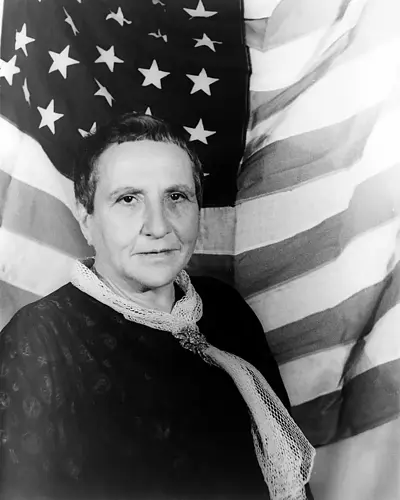
Gertrude Stein was an American novelist, poet, playwright, and art collector. Born in Pittsburgh, Pennsylvania in the Allegheny West neighborhood and raised in Oakland, California, Stein moved to Paris in 1903, and made France her home for the remainder of her life. She hosted a Paris salon, where the leading figures of modernism in literature and art, such as Pablo Picasso, Ernest Hemingway, F. Scott Fitzgerald, Sinclair Lewis, Ezra Pound, Sherwood Anderson and Henri Matisse, would meet.
