Aristotle Quotes
Such an event is probable in Agathon's sense of the word: 'it is probable,' he says, 'that many things should happen contrary to probability.'
Aristotle. Aristotle on the Art of Poetry. Translated by Ingram Bywater, Clarendon Press, 1909, p. 53.


This quotation was from a mathematician who was in the midst of the expansion of mathematics in the late 19th century to include the then rapid and rich development of Probability. This required mathematicians, scientists and others who would use the new mathematics to think in a very different way. For the existing mathematicians his quote clearly states the dilemma for them. Today, scientists and mathematicians have little trouble with “laws of probability” and realize that Probability is governed and controlled in the same way as other fields of mathematics; they are comfortable with different results occurring under the exact same experimental conditions, and those different results are unpredictable in any particular instance, but exactly predictable in terms of frequency of each possible occurrence. This makes Quantum Mechanics rational. However, few non scientists have had their thinking expanded and are comfortable with this thinking. Law and public policy makers are particularly vexed by not being able to think and work in this paradigm where consequences of something can be described for a population precisely, and yet be impossible to describe for any particular individual. This will improve over time, as politicians and other community leaders become better educated mathematically and scientifically.


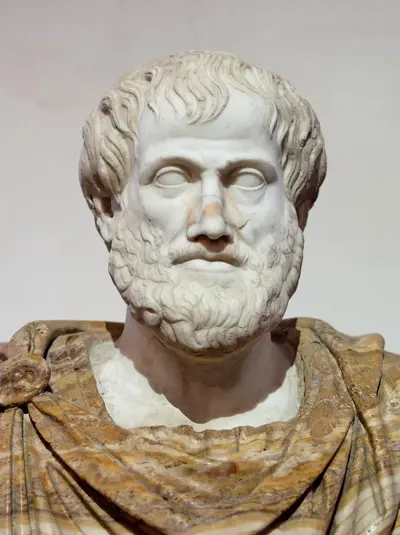
Aristotle (/ærɪˈstɒtəl/; Greek: Ἀριστοτέλης Aristotélēs, pronounced [aristotélɛːs]; 384–322 BC) was a Greek philosopher and polymath during the Classical period in Ancient Greece. Taught by Plato, he was the founder of the Lyceum, the Peripatetic school of philosophy, and the Aristotelian tradition. His writings cover many subjects including physics, biology, zoology, metaphysics, logic, ethics, aesthetics, poetry, theatre, music, rhetoric, psychology, linguistics, economics, politics, meteorology, geology and government. Aristotle provided a complex synthesis of the various philosophies existing prior to him. It was above all from his teachings that the West inherited its intellectual lexicon, as well as problems and methods of inquiry. As a result, his philosophy has exerted a unique influence on almost every form of knowledge in the West and it continues to be a subject of contemporary philosophical discussion.
