Hafez Al-Assad Quotes
Strike the enemy's settlements, turn them into dust, pave the Arab roads with the skulls of Jews.
Assad, Hafez al-. "Address to the Syrian Armed Forces." Radio Damascus, 24 May 1967.


Evelyn John St. Loo Strachey


During WWII, Mauldin was at the front lines and in the fox holes with the troops getting ideas for his cartoons most of which were drawn on the battle field;
The German catastrophic classification of people as superior and inferior did not start with the Nazis. It had been part of the German culture. What many feel makes Bismarck more cold-blooded than most Germans is that the latter were led to a hatred of the other ethnicities and would exterminate them for that reason, but Bismark had sympathy for the Poles yet advocated genocide simply on practical grounds. The analogy with the wolf shows this mentality at its worst.


He was leading the Gordon Highlanders of the British Army against the Boers during the Boer War. He was seriously wounded and could not go on himself with a charge he had ordered, However, waifing his sword he made this famous qutation. Particualrly noteorthy is the derrogatory terms which he used to describe the enemy--the Boers of South Africa. In many wars and cultures, one or more of the combatants, in order to overcome the avarage soldier's reluctance to kill an enemy, characterizes them as less than human. In this case, vermin, who were to be exterminated. There were two predominant groups of whites who came to South Africa, the English who were generally well-educated and were interested in trading with the exhisting inhabitants and investing in businesses using mostly native labot and the Boers. The latter were of Dutch and German origin, poor farmers with little or no land in the home country and little education. Their interest was to create a nation where they could own land to farm. And the lest expensive way for them to increase their farmland was to sieze it from the native Blacks and who were the major forces behind the racial discrimination which became apartheid. The British contolled the government and sought stability and as in most of the British Empire, they wanted English law to prevail including the rights of the Black natives. The Boers had left Europe for good and would thrive or not in Southern Africa. Proportiopnately, the English might have a career in South Africa or serve there for a few years. They were Englishmen in a foreign country. The Boers saw themselves as citizens of Southern Africa who were fighting the native Blacks for control of the land. The English legal system would not allow any of the land seizures and political discrimination that the Boers saw as existential for their survival in Africa. Soon, the Boers took more and more of the law into their own hands and saw English rule and dmination as inimical to their interests in Africa and they tried to create their own independent states in Southern Africa. That was the essense of the Boer Wars. Dick-Cunyngham was awarded the Victoria Cross, the highest military decoration of Great Britain, for his exploits in the Afghan War.


The Nazis and most of the Arabs were allies in WWII. The Jews of Palestine—although they were opposed to many of the British policies regarding Palestine—were active in the Allied cause contributing units to the British Army. Although the Germans were brutal to civilians, murdering millions, they refrained from public pronouncements or exhortations to kill civilians in most cases. The Arabs did not. The Mufti was actually given the rank of General in the Nazi SS and had his own SS unit. In this despicable exhortation he actually uses a concept and wording from the Koran. See {584355}. This quotation is important in that it refutes a common claim by some Palestinians that it was only the Germans who were responsible for the Holocaust and the post war Jewish Refugee problem and that the Palestinians had to bear the price rather than place Israel in Europe. This quotation and the other by the Grand Mufti prove that Palestinians were not only complicit in persecution of Jews but took a leadership and advocacy role.

The German designs for Polish destruction began long before World War II. Poland, created by the Treaty of Versailles, was seen be fanatic Germans as an example of French Hegemony.
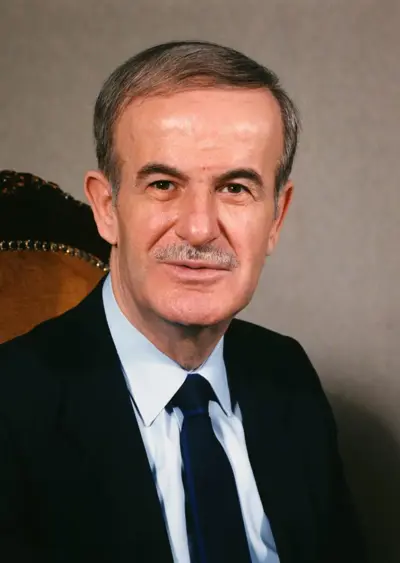
Hafez al-Assad was a Syrian politician who served as President of Syria from 1971 to 2000. He was also Prime Minister of Syria from 1970 to 1971, as well as regional secretary of the regional command of the Syrian regional branch of the Arab Socialist Ba'ath Party and secretary general of the National Command of the Ba'ath Party from 1970 to 2000.
