Irving Fisher Quotes
Stocks have reached what looks like a permanently high plateau.
Three days before the Great Depression Stock Market crash
Irving Fisher, 1867–1947, Professor of Economics & Statistics, Yale University, October 26, 1929
Sourced by: Eigen's Political and Historical Quotations


This may have been the worst stock market advice ever sent to customers. The Great Depression would suppress the economy of more than a decade.
There was. President Hoover and his aids were not the only ones to underplay the stock market crash of 1929.
The great scholars were as wrong as everyone else about the Great Depression
Major bankers were not only clueless in the Meltdown of 2008 and the Great Recession that followed, but they were equally hapless in the Market Crash of 1929 and the Great Depression thereafter.


When the stock market crashed, the Board of Governors was entertaining the idea of putting a syndicate of banks together or back some financiers who would buy up the stock that people were trying to sell. There were those who wanted to sell but no buyers at any price. They concept of a market was being destroyed. Lamont correctly explained that the idea was not practical—it was too late for that. Lamont however had underestimated the market crash and made a feeble effort to assist President Hoover make his feeble effort to get the American economy going again.

This is one of the worst economics assessments in the nation's history. Hoover had been a very successful business man prior to his government experience, but good business experience has not been a good predictor of Presidential success. See {633214} for more on this point.
President Hoover asked a group of prominent citizens to make recommendations to him regarding rumors of instability in the stock market. 10 days later was Black Tuesday where the stock market crashed and started the great depression.
He was one of the very few people who warned about the market crash of 1929 and the Great Depression.


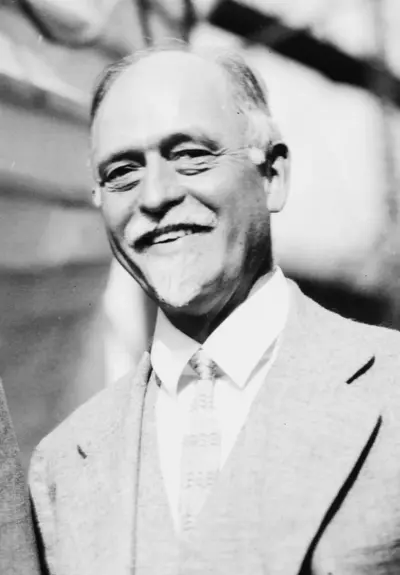
Irving Fisher (February 27, 1867 – April 29, 1947) was an American economist, statistician, inventor, eugenicist and progressive social campaigner. He was one of the earliest American neoclassical economists, though his later work on debt deflation has been embraced by the post-Keynesian school. Joseph Schumpeter described him as "the greatest economist the United States has ever produced", an assessment later repeated by James Tobin and Milton Friedman.
