Sandra Cisneros Quotes
Sometimes I feel I can't quite master my written and spoken Spanish, because I'm too much a student of English. I would need another lifetime to learn it.
Cisneros, Sandra. A House of My Own: Stories from My Life. Alfred A. Knopf, 2015.


He was one of the authors of the Bi-Lingual Education Act, but the nature of the program changed much from the original intent.

He was interviewed by PBS and asked why he introduced and financed California Proposition 227 the severely limited and curtailed bilingual education. Based on his success getting Proposition 227 passed in California, he tried to follow suit with Arizona Proposition 203, Colorado Amendment 31, and Massachusetts Question 2 which were not so successful. The research on Bilingual Education is mixed with some studies showing benefits and others not. Intuitively, the case against it was easier to sell as the objective was to develop English Proficiency and it was hard for many people to understand how that would better be accomplished if other classes were taught in a native language like Spanish. The other side point out that students who come the the United States very competent in Mathematics, Science and History get thrown into English speaking classes in those subjects and the fall behind very quickly. By the time their English is sufficient to take instruction in English, they have already failed the courses in which they used to be good and have to take them again if they are still in school which is rare since the lack of English skills causes them to fail all subjects if a Bilingual program is not available for their math, science, and history courses. Both sides of the argument have a point, but in many anti-Bilingual campaigns, the educational arguments gets lost and the issue becomes whether or not America should be an English speaking country, and Hispanic chauvinism and anti Hispanic racism end up driving much of the debate.


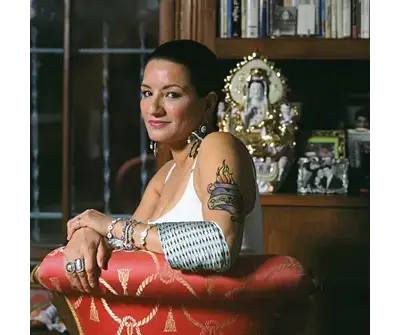
Sandra Cisneros is a Chicana writer. She is best known for her first novel, The House on Mango Street (1983), and her subsequent short story collection Woman Hollering Creek and Other Stories (1991). Her work experiments with literary forms that investigate emerging subject positions, which Cisneros herself attributes to growing up in a context of cultural hybridity and economic inequality that endowed her with unique stories to tell. She is the recipient of numerous awards, including a National Endowment for the Arts Fellowship, was awarded one of 25 new Ford Foundation Art of Change fellowships in 2017, and is regarded as a key figure in Chicana literature.
