Jurgen Habermas Quotes
Some of those drawn into the holy war had been secular nationalists only a few years before. If one looks at the biographies of these people, remarkable continuities are revealed.
Habermas, Jürgen. "Fundamentalism and Terror." Philosophy in a Time of Terror: Dialogues with Jürgen Habermas and Jacques Derrida, by Giovanna Borradori, U of Chicago P, 2003, p. 32.

From the latter part of the 20th century onward, religious nationalism was no longer a force for most religions and nations except Muslim countries. It was the only religion left where a large proportion of the adherents saw no distinction between the religion and the government. Nations that had separation of church and state were not conducive to the extreme fundamentalist form of Islam where the Secular Leader and the Religious leader was to be embodied as a single person. As a result Islamic religious nationalists argued for a Theocracy and at times fought for it with violent means. The secular government typically, to curtail the violence and prevent a religious takeover, often outlawed the extreme religious Islamic parties. While Aslan cites the Muslim Brotherhood failure in Egypt as a desirable outcome, the only way the other forces of Egyptian society could prevent the Islamists from taking over turning the country into a theocracy was to forcefully repress the extremists. The Turkish outcome was much better, but there was the threat of repression of the Justice and Development Party when it won a majority control of the government. There were explicit threats that if it tried to weaken the secular nature of the government as Ataturk had formulated it, the military would come “out of the barracks” and oust the government as they had done before. There were nations like China which persecuted religions such as certain forms of Christianity, but those religions were not fighting for religious nationalism. They only wished the freedom to practice their religion and had no program or theology that argued for Christianizing the government. The Tamil Hindus of Sri Lanka did not want a Hindu government and were perfectly free to practice their religion. The problem was that they felt that there was systemic social and economic discrimination against the Tamils and they fought for independence—not of a Hindu state, but of a secular, nondiscriminatory state of equal opportunity.


This clause has been the cause of immense problems in the Mid-East. Hamas castigates any Palestinian who even suggests that there should be negotiations with Israel that are sincere as nothing less than the end of Israel is consistent with their charter. Anyone who uses the peace process for anything else but tactical advantage and buying time to strike again is a traitor. Meanwhile, the clause is taken be Israel to demonstrate that there is no point to any negotiations so long as the Palestinian Authority allows such an organization with this charter clause to be legal and operate in the open. The Palestinian Authority leadership are not willing to risk a civil war, and thus little or no progress is made.

She is a leading American Arab who is a Syrian expatriate.


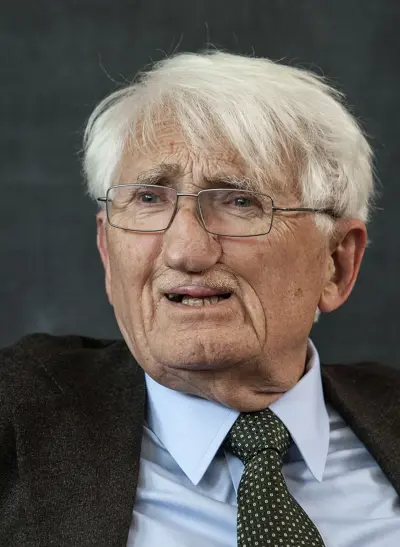
Jürgen Habermas is a German philosopher and sociologist in the tradition of critical theory and pragmatism. His work addresses communicative rationality and the public sphere.
