Harry S. Truman Quotes
Some of my best friends never agree with me politically.
The cultural norms of Congress change from era to era. In the 1930s and 1940s members of Congress could not fly back to their home districts for weekends and many, like Truman, did not have their spouse in Washington. There was a camaraderie among Congressmen—even members of opposite parties or political enemies. Also, while there was much divisiveness on most domestic policy issues, there tended to be much bipartisanship on foreign policy and procedural matters. At the opposite extreme, in the first years of the 21st century, there was little or no socializing among Congress members and certainly little between party opponents. One party had vowed to block all legislation so that they could say the President did not accomplish anything and limit him to a single term, and the other party saw the situation as advantageous as they could blame the Congressional failure on the other party. Few people had friends with whom they disagreed politically.
Harry S Truman, 1884-1972, 33rd President of the United States (Democrat, MO), Statement to a group of Congressional freshmen, July 2, 1947
Sourced by: Eigen's Political and Historical Quotations


While most talk show radio hosts in the political arena were highly partisan and not very polite about opinions contary to theirs and their major audience, Rehm was a real standout who not only was civil to all people regardless of view point but over her decades of broadcasting, always reminded her audience to also be so with suggestions like this classic.

In addition to the Attorney General, Washington’s cabinet consisted only of Thomas Jefferson, Secretary of State, and Alexander Hamilton, Secretary of the Treasury. Both were brilliant, passionate men dedicated to the new nation. However, they held opposite points of view on many major fundamental issues of political approach to the new nation. Washington greatly valued their advice and they each were magnificent administrators of their departments. However, they each distrusted each other intensely and believed that the other was advocating policies and practices that would destroy the new nation. Their squabbling was often public and Washington could never understand why they could not be civil about their disagreements. Ironically, Hamilton turned out to have been right about the assumption of state debt and the importance of business, finance and manufacturing. Jefferson whose vision had all Americans being farmers was wrong on this but was right on the limits of the executive and the rights of the individual vis a vis the government. Jefferson’s views turned out to be the ones most Americans wanted and his Democratic Republican party not only beat the Federalists but ended the Federalist Party. Hamilton died in a duel, Modern America is an amalgam of both of their views with modernity tending more and more towards Hamilton.


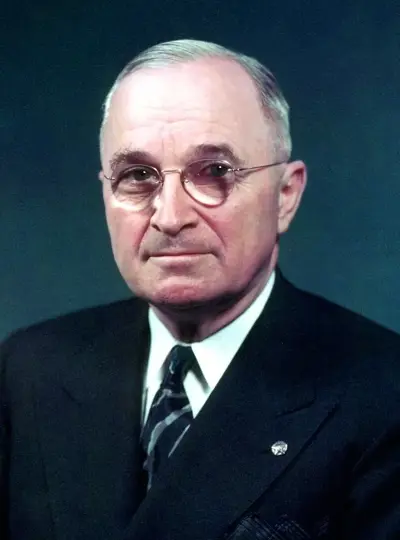
Harry S. Truman was an American politician who served as the 33rd President of the United States (1945–53). He served as a United States Senator from Missouri (1935–45) and briefly as Vice President (1945) before he succeeded to the presidency on April 12, 1945 upon the death of Franklin D. Roosevelt. He was president during the final months of World War II, and approved the plan to drop atomic bombs on Hiroshima and Nagasaki. Truman was elected in his own right in 1948. He presided over an uncertain domestic scene as America sought its path after the war and tensions with the Soviet Union increased, marking the start of the Cold War.
